


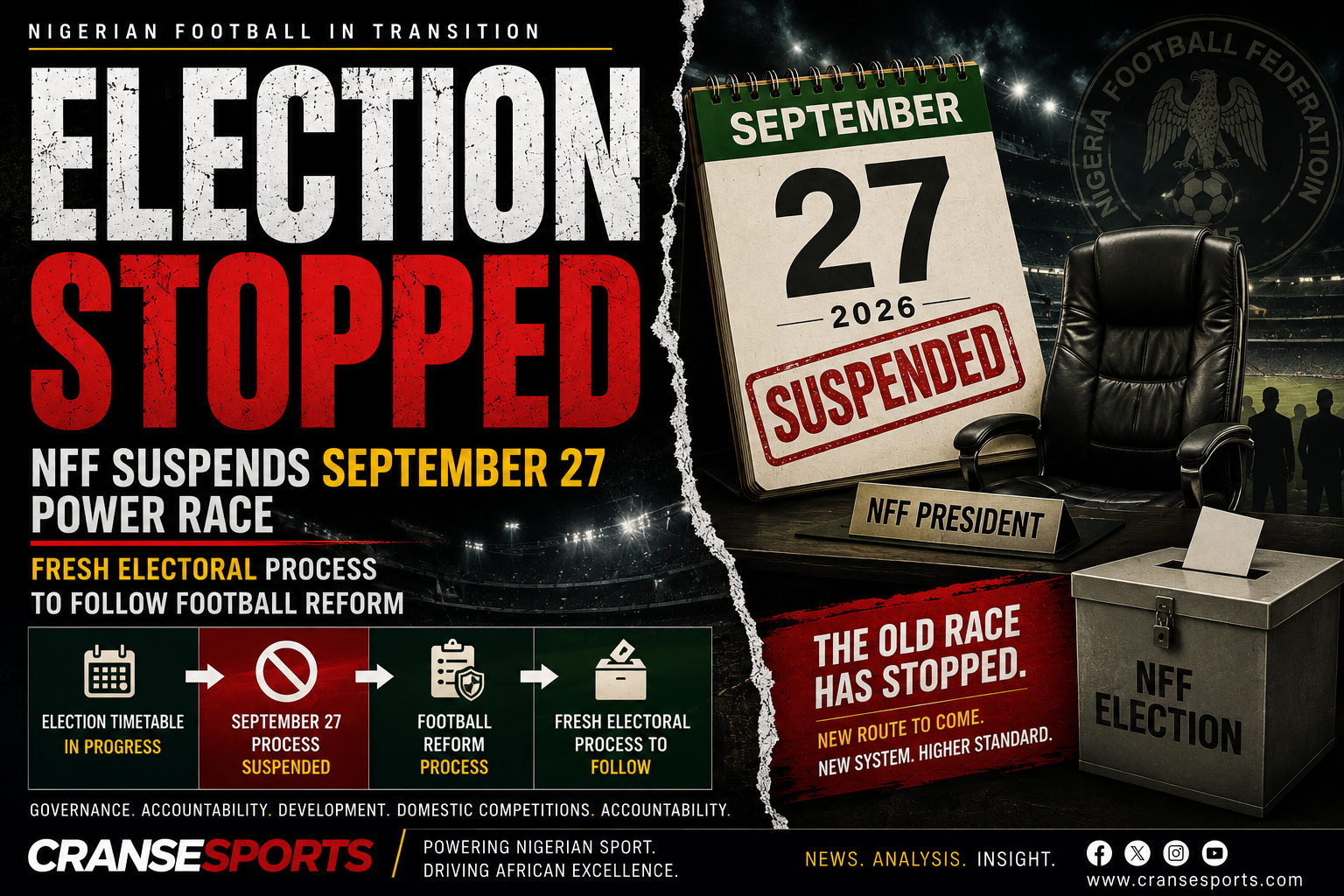
Nigeria’s football power race has been stopped in its tracks.
The Nigeria Football Federation has suspended all processes leading to the Elective Congress scheduled for September 27, effectively freezing the current succession timetable as the country enters a wider reform of its football system.
The federation says a fresh electoral process will begin after the anticipated reforms are completed.
For candidates, delegates and stakeholders already moving through the election cycle, that changes everything.
The contest for the next NFF leadership is no longer proceeding on the timetable that was in force just days ago.
Election Process Had Already Moved Into Gear
The September 27 congress was not a distant placeholder.
Preparations had already moved into an active electoral phase, with processes covering nomination forms, screening, appeals, campaigning and the eventual delegates list.
That entire route has now been suspended.
The significance goes beyond moving an election date.
Nigerian football is resetting the process through which its next leadership will emerge.
Reform Now Comes Before Election
The NFF says the fresh electoral process will begin after the comprehensive reforms envisaged for Nigerian football have been completed.
That puts reform ahead of succession.
President Bola Tinubu’s wider football reform directive targets governance, administration, stakeholder representation, development pathways, domestic competitions and accountability.
The process is also expected to involve engagement with FIFA and CAF while Nigeria maintains its obligations within the international football system.
That means the next NFF election could eventually take place inside a football structure different from the one that produced the suspended September 27 timetable.
Interim Secretariat Takes Control
The electoral suspension comes after a major leadership change at the federation.
NFF President Ibrahim Musa Gusau, General Secretary Mohammed Sanusi and members of the Executive Committee resigned as the reform process gathered pace.
Emmanuel Ikpeme has been endorsed to oversee the NFF Secretariat as interim General Secretary, while Ademola Olajire is serving as interim Deputy General Secretary.
Those interim arrangements are designed to maintain continuity while the wider reform process develops.
But the political consequence is immediate.
The race to replace the outgoing leadership has been frozen.
Domestic Football Also Feels the Reset
The transition extends beyond the NFF Secretariat.
The federation has directed the leadership of the NPFL, NNL, Nigeria Women Football League and Nationwide League One to hand administration to their Chief Operating Officers under the interim arrangement.
That puts the country’s domestic football structures directly inside the broader reset.
For the next NFF leadership, the question may therefore be bigger than simply who wins an election.
It may also be about what kind of system that leadership inherits.
Nigerian Football Faces a New Power Question
The September 27 congress was supposed to settle who would control the NFF for the next four years.
That question has now been pushed behind a larger one.
What structure will candidates eventually be seeking to lead?
No replacement election date has yet been announced.
Until the reform process defines the next electoral route, Nigerian football’s succession battle remains suspended alongside the timetable that was meant to settle it.
The old race has stopped.
When the new one begins, it may be fought under a very different system.
