


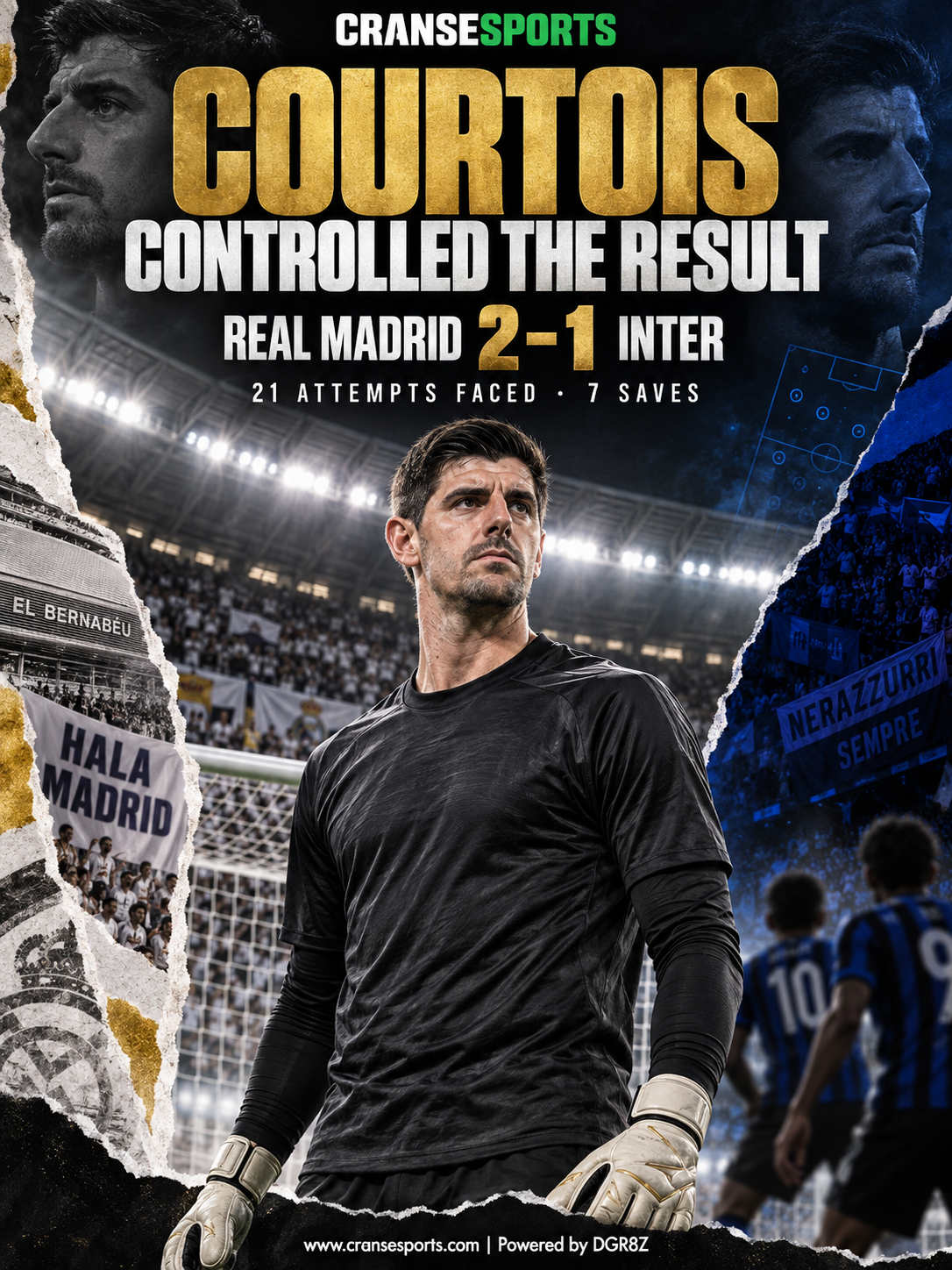
Kylian Mbappé and Federico Valverde punished two Inter errors, but Thibaut Courtois was the difference as Real Madrid survived long stretches of a Champions League opener they did not control at the Bernabéu.
Match at a glance
| Match data | Real Madrid | Inter |
|---|---|---|
| Score | 2 | 1 |
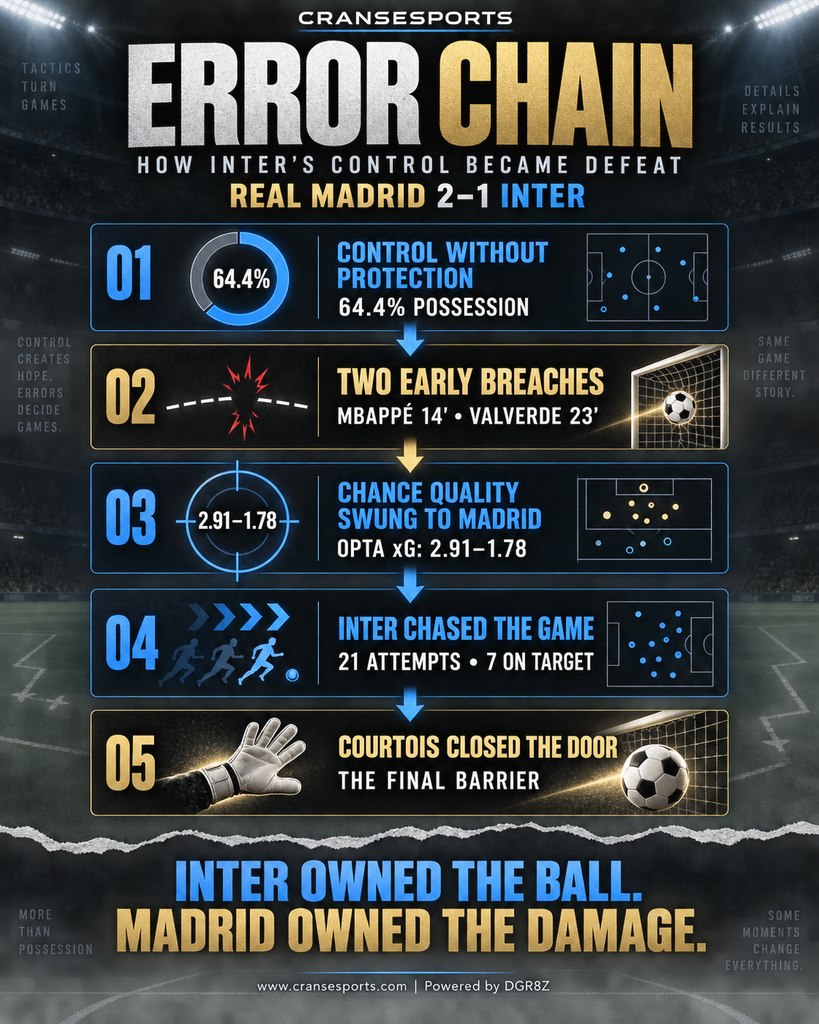
| Possession | 35.6% | 64.4% |
| Attempts | 16 | 21 |
| On target | 8 | 7 |
| Goalkeeper saves | 7 | 6 |
| Opta xG | 2.91 | 1.78 |
Scorers: Kylian Mbappé 14’, Federico Valverde 23’; Carlos Augusto 77’.
MADRID, Spain — Real Madrid collected the result. Inter controlled much of the match. Thibaut Courtois decided which of those two realities would matter when the final whistle arrived.
Madrid opened their 2026–27 Champions League campaign with a 2–1 victory over Inter at the Santiago Bernabéu, scoring through Kylian Mbappé and Federico Valverde before Carlos Augusto pulled one back for the visitors.
The scoreboard delivered three points to José Mourinho’s team. The performance delivered something less comfortable.
Inter had more than 64 per cent possession, attempted 21 shots and repeatedly played through Madrid’s midfield. Courtois made seven saves, including a critical late intervention, to stop that territorial superiority from becoming an equaliser.
Madrid did not control the night.
They controlled the decisive moments.
Two mistakes, two punishments
Inter started with confidence and carried the greater threat.
Marcus Thuram forced Courtois into an early save. Hakan Çalhanoğlu and Lautaro Martínez also tested the edges of Madrid’s defensive resistance as the Italian side established control of possession and territory.
Then the match changed with Madrid’s first meaningful attack.
Under pressure in the 14th minute, Yann Bisseck lost his footing and surrendered possession. Brahim Díaz collected the loose ball and released Mbappé, who drove his finish under Josep Martínez.
Madrid had barely established themselves in the contest. They were ahead.
Nine minutes later, Inter produced an even more damaging error.
Martínez received the ball close to his goal line and attempted to escape Valverde with a drag-back. The goalkeeper failed to complete the move, allowing the Uruguayan midfielder to poke the ball into the net.
Two Madrid shots had produced two goals.
That sequence could be dismissed as Inter self-destruction, but it would ignore Madrid’s contribution. Both goals came from pressure applied high up the pitch. Mourinho’s side did not dominate the ball, but they identified moments of indecision and attacked them without hesitation.
The mistakes belonged to Inter. The punishment belonged entirely to Madrid.
The numbers did not match the score
By half-time, the contradiction had become extraordinary.
Inter reportedly held approximately 70 per cent possession and led the attempt count 12–3. Madrid had struggled to build through midfield, while the visitors moved around and through the home side with unsettling ease.
Yet Madrid led 2–0.

Curtis Jones hit the crossbar during one of Inter’s most dangerous first-half attacks. Courtois denied further efforts, while Inter continued to produce entries into the Madrid penalty area without finding the finish their performance appeared to deserve.
Madrid also had opportunities to stretch the lead.
Jude Bellingham was denied from close range by Martínez, who recovered from his costly mistake to make several important saves. Díaz then struck the post as the contest moved from Inter control into something more chaotic.
The scoreline suggested a comfortable Madrid advantage. Almost every other indicator suggested an open match that could still turn.
That separation between score and performance became the defining feature of the night.
Courtois controlled the result
The second half developed into a contest between the goalkeepers.
Martínez used his legs to deny Mbappé and produced further saves as Madrid searched for the third goal that would have killed the contest. At the opposite end, Courtois continued to protect a midfield and defence that were conceding too many opportunities.
The Belgian goalkeeper’s influence went beyond the number of saves.
Every intervention allowed Madrid to reset and preserved the value of the two mistakes they had already forced and punished.
Inter finally broke through in the 77th minute.
Lautaro Martínez delivered a low ball into the area and Carlos Augusto converted to reduce the deficit. The goal transformed the closing phase, pushing Madrid deeper and giving Inter reason to believe their control might still produce a point.
Courtois refused to allow it.
His late save from Henrikh Mkhitaryan preserved Madrid’s advantage and completed a performance worthy of his 100th Champions League appearance.
Valverde scored what proved to be the winning goal, but later acknowledged that Courtois had been Madrid’s outstanding player.
That assessment was difficult to challenge.
Efficiency or warning?
Madrid finished with 16 attempts to Inter’s 21. They recorded eight shots on target against Inter’s seven, while Opta’s expected-goals model placed the teams at approximately 2.91 to 1.78 in Madrid’s favour.
Those figures add necessary context.
Inter controlled possession and produced greater shot volume, but Madrid still created enough high-quality opportunities to extend the lead. Bellingham, Mbappé and Díaz all had chances beyond the two goals.
This was not a simple case of Madrid scoring twice and defending for their lives.
It was a match in which Mourinho’s team created danger through pressure and transition but failed to establish stable control between those moments. Madrid could have scored more. Inter could also have forced an entirely different result.
That volatility may be entertaining in September. It becomes dangerous when the competition reaches its decisive stages.
The Madrid press looked aggressive and purposeful near Inter’s goal. Behind that first line, however, space repeatedly appeared. Once Inter escaped the initial pressure, they found routes through midfield and into attacking areas.
After the match, Mourinho acknowledged that Trent Alexander-Arnold had filled a specialised midfield role that was not natural to him. The experiment contributed to a structure that could attack Inter’s build-up but struggled to contain the visitors once the press was beaten.
Madrid’s most important work after this victory will therefore involve connecting those two parts of the team.
Pressure without midfield control produces chaos. Against Inter, Courtois ensured that chaos ended in Madrid’s favour.
Mbappé reaches another European landmark
Mbappé’s opener carried historical weight.
The goal took him to 71 in the Champions League, drawing him level with Real Madrid great Raúl in the competition’s all-time scoring standings.
It was another demonstration of what makes Mbappé so dangerous in Europe. He did not require Madrid to control the match or construct a long sequence of possession. One turnover, one pass and one direct run were enough.
That capacity gives Madrid protection even when the wider performance is imperfect.
The same applies to Valverde. His goal came from recognising the vulnerability around Martínez and continuing his pressure until the goalkeeper made the mistake.
Madrid’s elite players can convert unstable moments into decisive ones. That is a strength, but it should not become an excuse for failing to control matches.
Inter lost the result, not the argument
Inter leave Madrid without a point, and Cristian Chivu will have to confront the individual mistakes that undermined an otherwise forceful performance.
At this level, control without precision is fragile.
Bisseck’s loss of possession and Martínez’s failed attempt to escape Valverde gave Madrid an advantage Inter could not overturn. Twenty-one attempts and more than 64 per cent possession cannot erase those decisions.
Still, Inter’s performance offered evidence that they can trouble elite opposition.
They played through Madrid, created chances and kept the Bernabéu uncomfortable until the final whistle. If the defensive errors can be removed, the wider structure gives Chivu something substantial to build on.
Madrid face the opposite calculation.
They have the points and the attacking quality, but Mourinho has been given a clear warning about the spaces inside his team.
Three points—and a problem left behind
Champions League campaigns are not decided by possession percentages or aesthetic control. They are decided by results, and Madrid secured the result they needed.
They also revealed why this team remains difficult to trust completely.
The pressure that created both goals was real. The ruthlessness of Mbappé and Valverde was real. The quality of Courtois was decisive.
So was Inter’s ability to move through Madrid and create sustained danger.
Mourinho can reasonably celebrate the victory. He must also recognise that relying on a goalkeeper to rescue structural weaknesses is not a sustainable European plan.
Madrid won because they converted Inter’s errors and protected their lead through an exceptional goalkeeper.
Inter controlled long passages of the fight.
Courtois controlled the result.
