



Nigeria Have One More Wall to Break — and Mali Are Waiting Again
Nigeria have survived the noise, the pressure and a three-point semi-final against the host nation.
Now comes the wall they could not break two years ago.
The Junior D’Tigress face Mali in Sunday’s FIBA U18 Women’s AfroBasket final at the Palais des Sports de Treichville in Côte d’Ivoire, with the continental title at stake and a recent piece of history demanding an answer.
This is not an unfamiliar final.
Mali defeated Nigeria 76–56 in the 2024 championship game, leaving the Junior D’Tigress with more than a trophy to chase when the teams meet again.
Nigeria now have the opportunity to overturn a matchup that has previously belonged to the defending champions.
A Trophy, a Rematch and a Chance to Shift the Order
Both teams have already secured Africa’s places at the 2027 FIBA U19 Women’s Basketball World Cup in China by reaching the final.
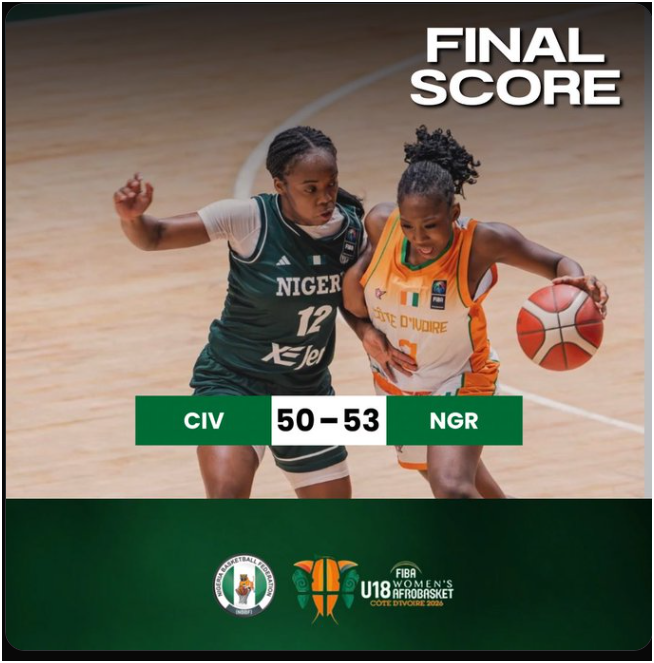
Nigeria booked their place after eliminating hosts Côte d’Ivoire 53–50 in a tense semi-final.
So Sunday is no longer about qualification.
It is about supremacy.
Nigeria enter their second consecutive final with a 4–1 tournament record. Their only defeat came by a single point, 75–74, against Cameroon in the group stage.
The Junior D’Tigress responded by beating Senegal 70–40, crushing Cameroon 75–45 in the quarter-finals and then surviving Côte d’Ivoire.
Mali have taken an even more ruthless road.
The defending champions opened with a 124–20 victory over Benin, beat Morocco 103–30, survived Egypt 62–57, overwhelmed Kenya 93–22 in the quarter-finals and edged Egypt again, 57–55, to reach the championship game.
They now stand in a seventh consecutive final dating back to 2014.
That is the pressure board: Nigeria’s resistance against Mali’s championship machinery.
Can Nigeria’s Defence Drag Mali Into Chaos?
Nigeria’s semi-final against Côte d’Ivoire was ugly, close and revealing.
There were 11 lead changes and seven ties. Nigeria led only 27–23 at half-time and were forced to survive a second-half fightback before closing out the 53–50 victory.
The Junior D’Tigress shot only 24 per cent from the field but stayed alive through defence, rebounding and persistence.
Captain Favour Joy Anari has been central to that pressure.
She enters the final as Nigeria’s leading scorer at 12.8 points per game, while also averaging 5.6 assists and 6.0 steals.
Anari scored 15 points and supplied four assists in the semi-final.
If Nigeria are to pull Mali away from their preferred rhythm, her ability to attack passing lanes and turn defensive pressure into extra possessions could become one of the defining elements of the final.
Can Nigeria Survive Mali on the Glass?
The danger is not limited to Mali’s scoring.
Assan Bagnine Mariko gives the champions major rebounding presence and produced 12 points and 14 rebounds in the semi-final victory over Egypt.
That makes Nigeria’s work around the basket potentially decisive.
Zainab Adelaja leads Nigeria at 7.8 rebounds per game, with Precious Grace Aladelua averaging 7.6 and Nimah Ibidunni 6.4.
Against Mali’s size, Nigeria cannot afford to defend well for 20 seconds and then lose the possession through an offensive rebound.
One loose rebound could mean another shot.
Too many could mean the title.
Pressure Against Control
The clearest tactical collision is between Nigeria’s ability to disrupt possessions and Mali’s capacity to control them.
Nigeria have a defensive playmaker in Anari.
Mali have one of the tournament’s major creators in Maimouna Traore, while captain Couda Keita has emerged as one of their most dangerous scoring threats.
Keita produced 24 points, seven rebounds and three assists when Mali needed her most against Egypt.
The central question is straightforward:
Can Nigeria turn Mali’s ball-handling into a fight before the champions establish their half-court offence?
If the Junior D’Tigress can force turnovers, run the floor and avoid spending long stretches wrestling with Mali’s size in set offence, the game can move towards Nigeria’s strengths.
If Mali protect the ball, feed their interior advantage and control the boards, Nigeria could be pushed into a half-court scoring contest with almost no margin for error.
The Players Carrying the Final
Favour Joy Anari — Nigeria
Nigeria’s captain, leading scorer, primary creator and leading ball thief.
The Junior D’Tigress’ pressure game increasingly runs through her.
Zainab Adelaja — Nigeria
One of Nigeria’s most important rebounders and their most efficient player in the semi-final.
Her work around the basket becomes even more important against Mali.
Nimah Ibidunni — Nigeria
Ibidunni pulled down 12 rebounds against Côte d’Ivoire.
Nigeria may need the same aggression again if they are to deny Mali second chances.
Couda Keita — Mali
Mali’s captain delivered 24 points in the semi-final.
When the defending champions needed an offensive leader in their tightest game of the tournament, Keita carried the burden.
Assan Bagnine Mariko — Mali
Her 14 rebounds against Egypt underline the physical problem Nigeria must solve inside.
Maimouna Traore — Mali
A major part of Mali’s creative engine and one of the tournament’s leading playmakers.
Nigeria Have Recovered. Mali Have Not Lost.
Nigeria’s road to the final has demanded recovery.
After losing 75–74 to Cameroon, the Junior D’Tigress have won three consecutive games — 70–40 against Senegal, 75–45 against Cameroon in the rematch and 53–50 against Côte d’Ivoire.
Mali have not lost at all.
But their last two meetings with Egypt produced victories by only five and two points.
The 57–55 semi-final was their narrowest win of the tournament.
Mali are formidable.
They are not untouchable.
Three Battles That Could Decide the Final
Nigeria’s turnover pressure against Mali’s creation.
Anari’s defensive disruption meets a Mali offence built around controlled creation and execution.
Defensive rebounding.
Nigeria must finish possessions. Mariko gives Mali a powerful route to repeated attacks when the first shot fails.
Nigeria’s offensive efficiency.
The Junior D’Tigress survived Côte d’Ivoire despite shooting only 24 per cent from the field. Repeating that against Mali would leave almost no margin for error.
More Than a World Cup Ticket
Nigeria have already achieved one major objective by qualifying for the 2027 U19 Women’s World Cup.
The final now asks a harder question.
Can another Nigerian women’s national team convert youth promise into continental authority?
The Junior D’Tigress have already shown they can recover from defeat, survive hostile pressure and win ugly.
Now they have to beat the champions.
Forget consolation.
Forget qualification.
Nigeria have been here before, and Mali sent them home without the trophy.
Two years later, the champions are waiting again.
Mali carry the perfect record and the recent history. Nigeria carry the rematch. On Sunday, one of them carries Africa’s trophy home.
