


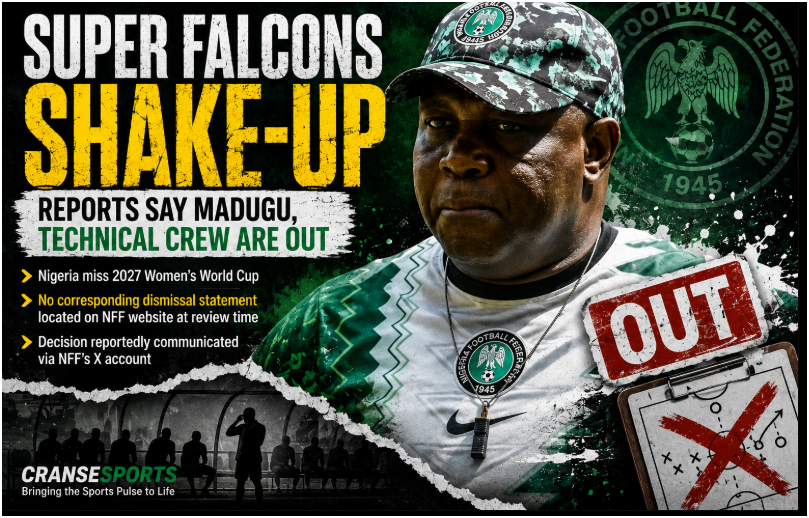
Super Falcons Shake-Up: Reports Say NFF Dismisses Madugu, Technical Crew After World Cup Failure
The fallout from Nigeria’s failure to qualify for the 2027 FIFA Women’s World Cup has reportedly claimed the Super Falcons’ technical crew, with multiple outlets reporting that head coach Justine Madugu and his backroom staff have been asked to step down.
The reported decision lands only days after Nigeria’s World Cup hopes collapsed and immediately throws the future direction of one of Africa’s most successful women’s national teams into focus.
ESPN, TheCable and other Nigerian outlets have reported Madugu’s dismissal, with secondary reports saying the directive covered the Super Falcons technical crew and took immediate effect. The development was also captured across CranseSports’ August 18 monitoring file.
But there is an important gap in the official website record.
At the time of CranseSports’ review on 18 August 2026, no corresponding dismissal statement was located on the Nigeria Football Federation’s official website.
That matters because the absence of a detailed dismissal notice on the federation’s website leaves several important questions unresolved from official website material.
The exact mechanism of Madugu’s departure, contractual implications, detailed effective arrangements, the identity of any replacement coach and the internal deliberations that produced the reported decision have not been set out in a corresponding NFF website announcement reviewed by CranseSports.
Secondary reports say the directive was communicated through the federation’s X account. CranseSports has not independently authenticated the specific post, so that element remains attributed rather than presented as independently verified official confirmation.
What is already established is the scale of the crisis that preceded the reported coaching change.
Nigeria’s route to the 2027 Women’s World Cup ended after a 2-1 defeat to South Africa in the African playoff, breaking the Super Falcons’ run of appearances at every edition of the tournament since its launch in 1991.
For a national team accustomed to continental dominance and uninterrupted World Cup participation, the failure represented far more than another bad result.
Madugu had entered the tournament cycle carrying significant authority after guiding Nigeria to the previous Women’s Africa Cup of Nations title. But the defence unravelled, and the Super Falcons were unable to recover their World Cup position through the playoff route.
Madugu subsequently accepted responsibility for the failure as pressure intensified around the technical team.
The NFF then moved beyond the dugout by establishing a fact-finding committee chaired by Fanny Amun to investigate recent national-team setbacks, with particular attention to the Super Falcons’ failure to reach the World Cup.
That broader inquiry means the reported dismissal cannot be separated from the deeper questions confronting Nigerian football.
Removing the coaching team may identify the first people to pay the price.
It does not settle the argument over responsibility.
Who rebuilds the Super Falcons? What technical structure comes next? How quickly can Nigeria recover from losing its ever-present World Cup status? And will the federation’s investigation identify problems that stretch beyond Madugu and his staff?
Until those answers emerge, Nigerian women’s football is no longer dealing only with the pain of missing a World Cup.
It is now dealing with the fight over what comes next.
