


NFF Deadline Day: Submission Window Closes Today as Reform Fight Deepens
Nigeria’s football election enters a decisive phase on Wednesday as nomination submissions reach their deadline, with the federation’s September vote already under pressure from competing calls for reform, suspension and continuity.
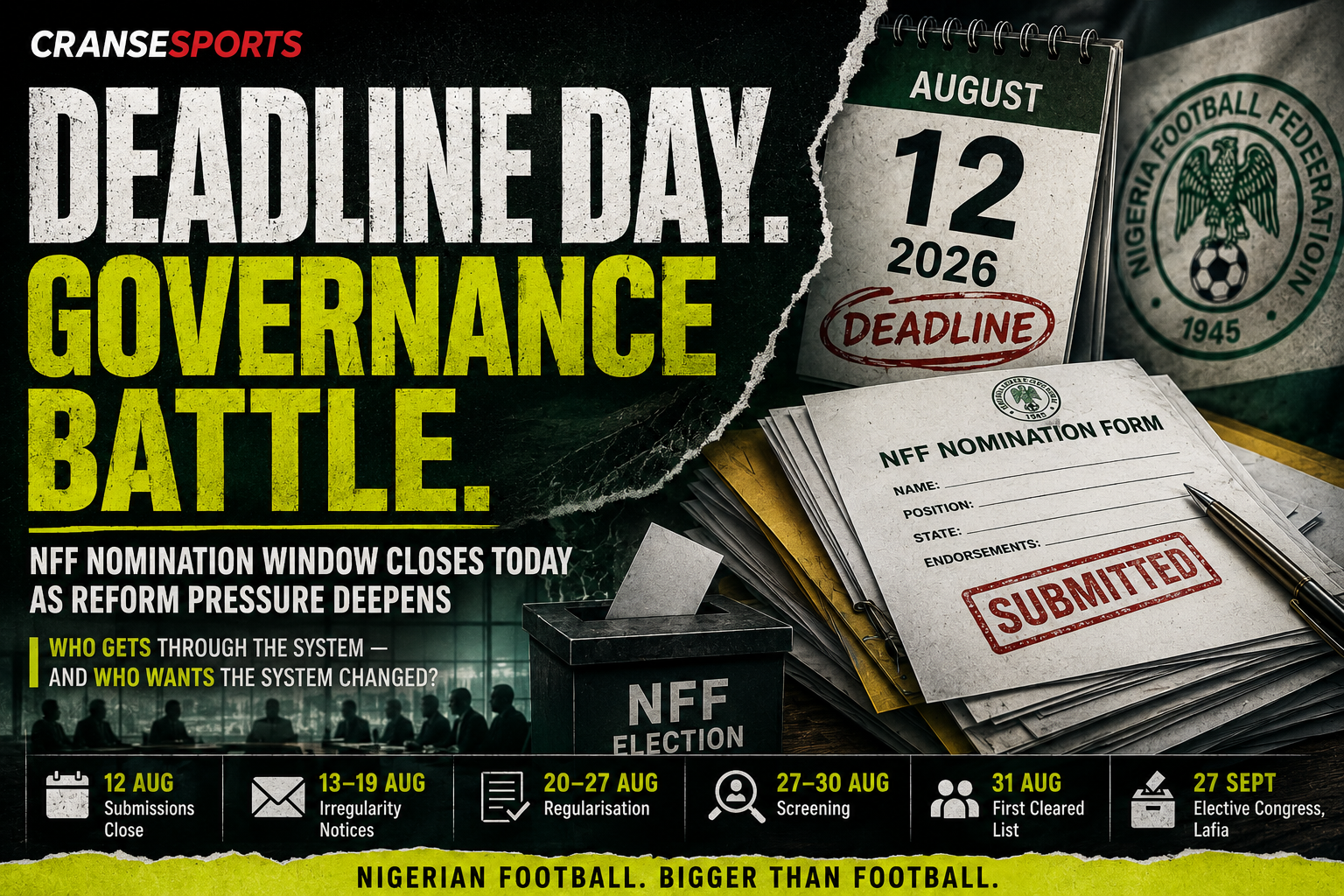
The race for control of Nigerian football moves into a sharper phase on Wednesday, 12 August, when the Nigeria Football Federation’s deadline for submission of collected nomination forms expires.
The NFF Electoral Committee’s official roadmap places the deadline at the end of a process that began with the sale of forms on 1 August.
From Thursday, the committee is scheduled to begin notifying aspirants of irregularities in submitted documents before a regularisation period and screening process later this month.
The first cleared list is due on 31 August, while the Elective Congress is scheduled for 27 September in Lafia, Nasarawa State.
That timetable matters because the biggest argument around the election is no longer simply about who wants to run.
It is about who can get through the system and onto the ballot.
Reform pressure hits the election

Former Nigeria international Chief Segun Odegbami has called for the process to be temporarily suspended, arguing that the structure of football administration needs deeper reform before another election is conducted.
Facilities executive Ebi Egbe has also criticised the influence of state football association chairmen within the NFF Congress, saying the existing structure gives too much power to entrenched interests.
But there is no single stakeholder position.
Football administrator Ahmed Shuaibu Gara-Gombe has rejected the idea that the election itself should be stopped, even while supporting broader reform of the system.
That split has turned the countdown to September into something larger than a normal federation election: a contest over whether Nigerian football should change its leadership through the existing architecture or first change the architecture itself.
LATEST POSTS
- Nigeria Football Reform: Who Controls the NFF Reset?
- Falconets vs Colombia: Nigeria’s World Cup Revival Faces Biggest
- Cardiff enters Joshua-Fury venue race as negotiations continue
- Real Madrid Won. Inter Controlled the Fight. Courtois Decided the Rest.
- Eguavoen Takes Charge of Super Falcons’ Olympic Bid
Endorsement rules add another pressure point
The pressure has intensified around endorsement requirements for senior positions.
The Nation reports that presidential aspirants have appealed to the Presidency, National Assembly and National Sports Commission to intervene, alleging that the nomination rules are making it difficult for challengers to secure the geographical spread of endorsements required to reach the ballot.
Those complaints are serious, but they are not proof that the election has been predetermined.
The claims were made by unnamed aspirants, and CranseSports is therefore treating the alleged endorsement blockade as an attributed grievance, not an established finding of manipulation.
That distinction becomes even more important on deadline day.
Some figures have already declared ambitions for different NFF positions, but a public declaration is not the same thing as a valid nomination, and neither is the same thing as being cleared for the ballot.

Sports administrator Segun Solanke, for example, publicly declared an intention to contest the NFF presidency and framed his campaign around governance, grassroots development and Nigerian football performance.
But reporting published before forms went on sale indicated that he had not purchased a nomination form at that stage.
That is why Wednesday’s close of submissions is an important first cut.
The next stages will determine which ambitions survive documentation checks, regularisation and screening.
What happens next
For Nigerian football, the consequence goes beyond personalities.
The election will determine the federation’s next Executive Committee at a time when scrutiny of Nigerian football governance is intensifying.
The contest is unfolding against wider public pressure over Nigerian football administration and results.
The current debate is therefore carrying two competing demands at once:
change the people, or change the system that chooses them.
The NFF’s timetable now provides the next hard checkpoints.
After Wednesday’s submission deadline, aspirants with document irregularities are due to be notified between 13 and 19 August, regularisation is scheduled from 20 to 27 August, screening from 27 to 30 August, and the first cleared list is due on 31 August.
Until those stages are completed, there is no authoritative final candidate field.
What is already clear is that the fight over Nigerian football’s next leadership has begun before the ballot itself.
