


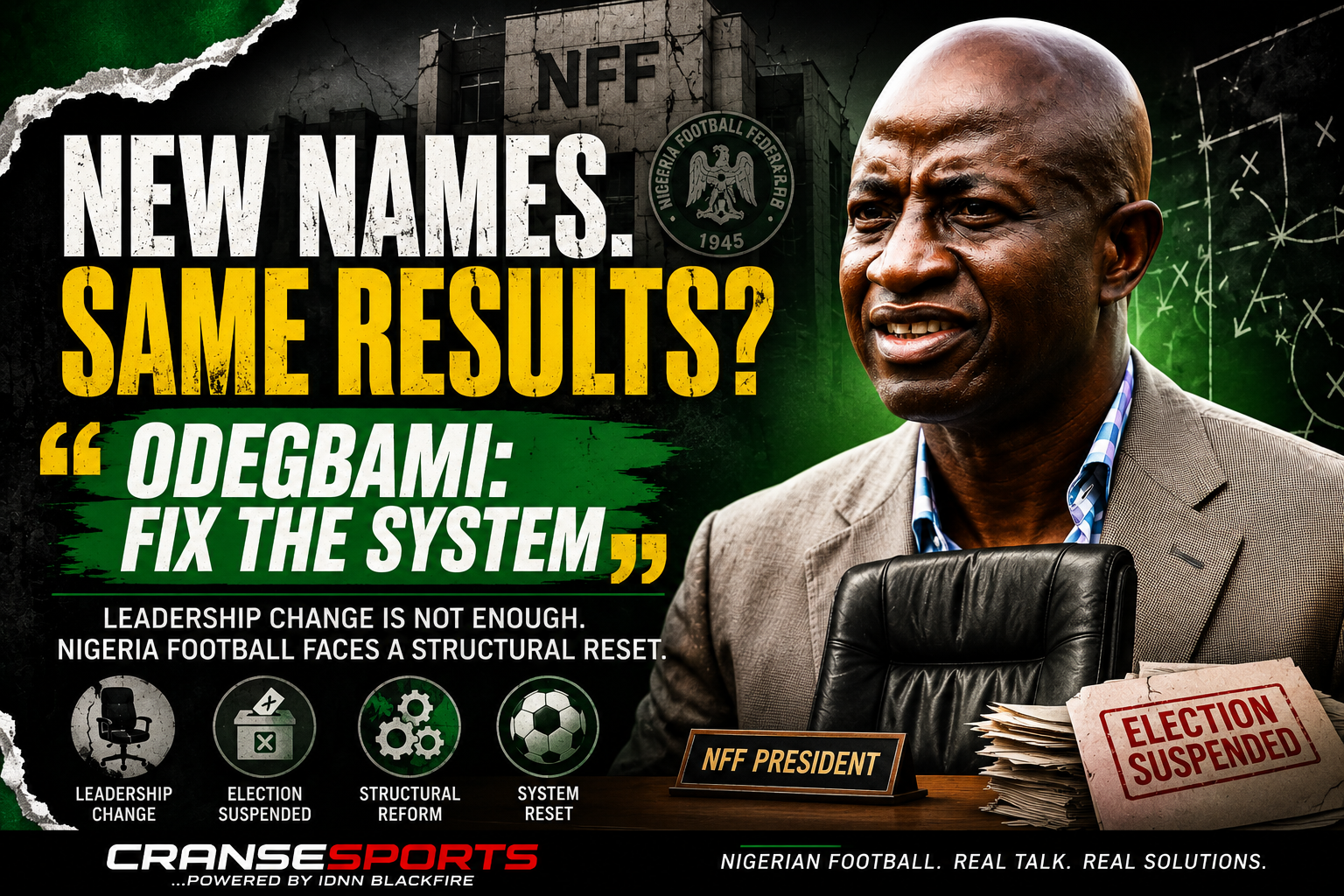
Ibrahim Gusau has left the Nigeria Football Federation. Segun Odegbami’s warning is that Nigeria should not mistake an empty presidential seat for a repaired football system.
The former Nigeria international says changing the people running the NFF will deliver little if the deeper administrative, structural and developmental problems surrounding the game remain untouched.
Speaking after the resignations of Gusau, General Secretary Mohammed Sanusi and members of the NFF Executive Committee, Odegbami argued that Nigerian football’s problems cannot be solved by another simple change of personnel.
Central warning
Replace the administrators without fixing the system and Nigeria risks getting the same results. That turns the NFF shake-up into something bigger than a resignation story.
Gusau’s departure is confirmed. So is the wider transition around the federation. Emmanuel Ikpeme is overseeing the NFF Secretariat as interim General Secretary, while Ademola Olajire is serving as interim Deputy General Secretary.
Processes connected to the September 27 elective congress have also been suspended pending a fresh electoral process after anticipated reforms.
But Odegbami’s argument cuts through the scramble over who comes next. His position is that who occupies the offices matters less if the machinery underneath them keeps producing the same failures. He has described Nigerian football’s problems as administrative, structural and developmental, arguing for a sustainable system capable of producing stability rather than another cycle built around personalities.
That argument lands at a moment when structural reform is no longer merely a former player’s talking point.

Government is demanding reform
President Bola Tinubu has directed a comprehensive reform of Nigerian football, with governance, administration, stakeholder representation, development pathways, domestic competitions and accountability among the areas under scrutiny. The National Sports Commission has been tasked with working alongside the NFF Secretariat and other stakeholders, while FIFA and CAF engagement is also expected.
The overlap is impossible to ignore. The federation’s leadership has stepped down. The electoral process has been halted.
And one of Nigerian football’s most recognizable former internationals is warning that simply filling the vacant chairs could bring the country back to the same point.
For supporters, the test is less theoretical. Nigeria’s football administration came under intense pressure after major national-team setbacks, including the Super Eagles missing the 2026 World Cup and the Super Falcons failing to reach the 2027 Women’s World Cup. That is why the next NFF leadership will inherit more than offices.
It will inherit a credibility test.
Nigeria now has an opportunity to decide whether this moment becomes another cycle of resignations, appointments and disappointment or the point at which the structure itself is redesigned.
Gusau is gone.
The harder job is making sure Nigerian football does not simply arrive back at the same crisis with different names.
Cranse Sports
News For Fans Who Read The Game
