



Nick Kyrgios has been removed from professional tennis while an anti-doping case involving a positive test for a cocaine metabolite moves through the sport’s disciplinary process.
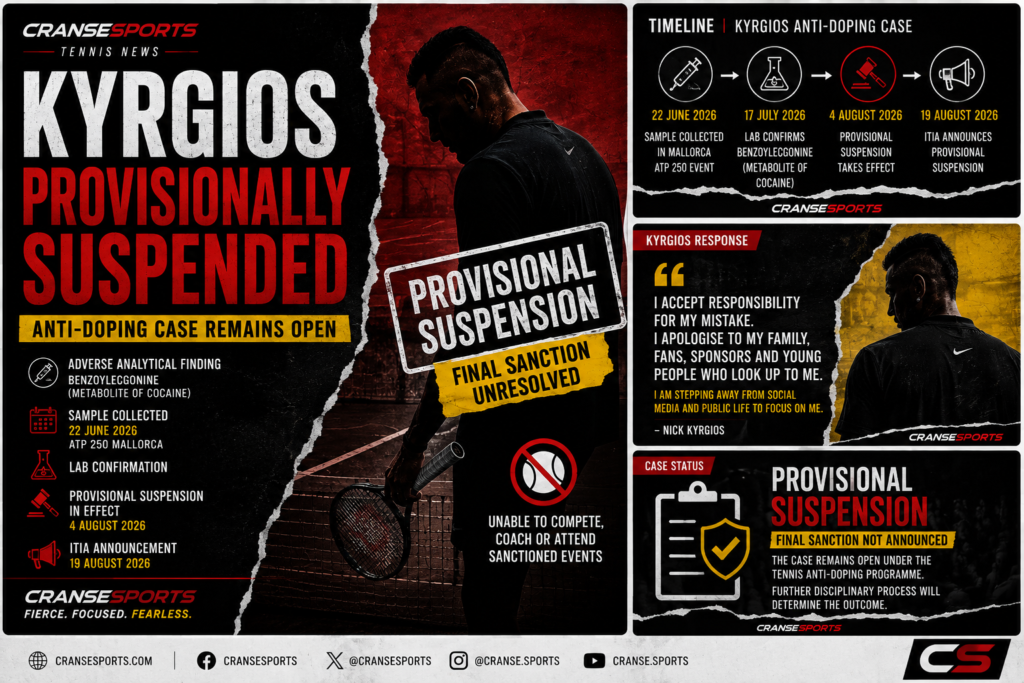
The International Tennis Integrity Agency announced on 19 August 2026 that the Australian has been provisionally suspended under the Tennis Anti-Doping Programme after a sample provided during the ATP 250 event in Mallorca on 22 June returned a finding for benzoylecgonine, a metabolite of cocaine.
A World Anti-Doping Agency-accredited laboratory confirmed the finding on 17 July. The provisional suspension has been in force since 4 August.
This is not yet a final ban.
But while the suspension remains active, Kyrgios is out of sanctioned professional tennis.
What the provisional suspension means
The ITIA says cocaine is classified as a stimulant and a substance of abuse on the WADA Prohibited List and is prohibited in competition under tennis anti-doping rules.

Because of the substance involved, the agency says a provisional suspension is mandatory. While that suspension remains active, Kyrgios cannot play in, coach at or attend events organized or sanctioned by World Tennis, the ATP, WTA, Grand Slam tournaments or national associations.
The ITIA also stated that Kyrgios had not appealed the provisional suspension as of its 19 August announcement.
That distinction matters.
A provisional suspension removes him from competition immediately. It does not, by itself, determine how long any final sanction may last.
Kyrgios takes responsibility
Kyrgios responded publicly after the case was announced and acknowledged the positive test. He said he had made a serious mistake, apologized to his family, fans, sponsors and younger supporters, and accepted responsibility.
He also spoke about the physical and mental strain created by recent injuries and uncertainty around his career, while making clear that those pressures were not an excuse. Kyrgios said the situation had become a wake-up call and that he planned to step away from social media and public life temporarily while focusing on himself.
The apology changes the human context of the case. It does not change its procedural status.
The ITIA remains the authority governing the anti-doping process.
The timing deepens the pressure
For Kyrgios, the case lands in a career already disrupted by injuries and repeated attempts to rebuild momentum. The Australian reached the Wimbledon final in 2022 and climbed as high as world No. 13, but recent seasons have been shaped by physical setbacks as much as his ability to produce explosive tennis.
He was competing in Mallorca when the sample at the center of the case was taken.
Now the question is no longer simply whether Kyrgios can stay healthy enough to mount another comeback.
It is when and under what disciplinary conditions he will be permitted to return.
What happens next is still unresolved
The most important fact around this case is also the one that must not be overstated.
No final sanction has been announced. The current ITIA action is a provisional suspension.
Any future period of ineligibility will depend on the disciplinary process and any final determination made under tennis anti-doping rules. Until that changes, headlines declaring Kyrgios banned for a specific period would run ahead of the authority record.
What is established is serious enough.
A sample taken during an ATP event produced a confirmed finding for a cocaine metabolite. The sport’s integrity body imposed a mandatory provisional suspension.
Kyrgios has accepted responsibility publicly.
And for now, one of tennis’s most recognizable and polarizing players cannot compete, coach or attend sanctioned professional events. The next decisive development will come from the disciplinary process not speculation over how long his absence might last.
Cranse Sports
News For Fans Who Read The Game
