


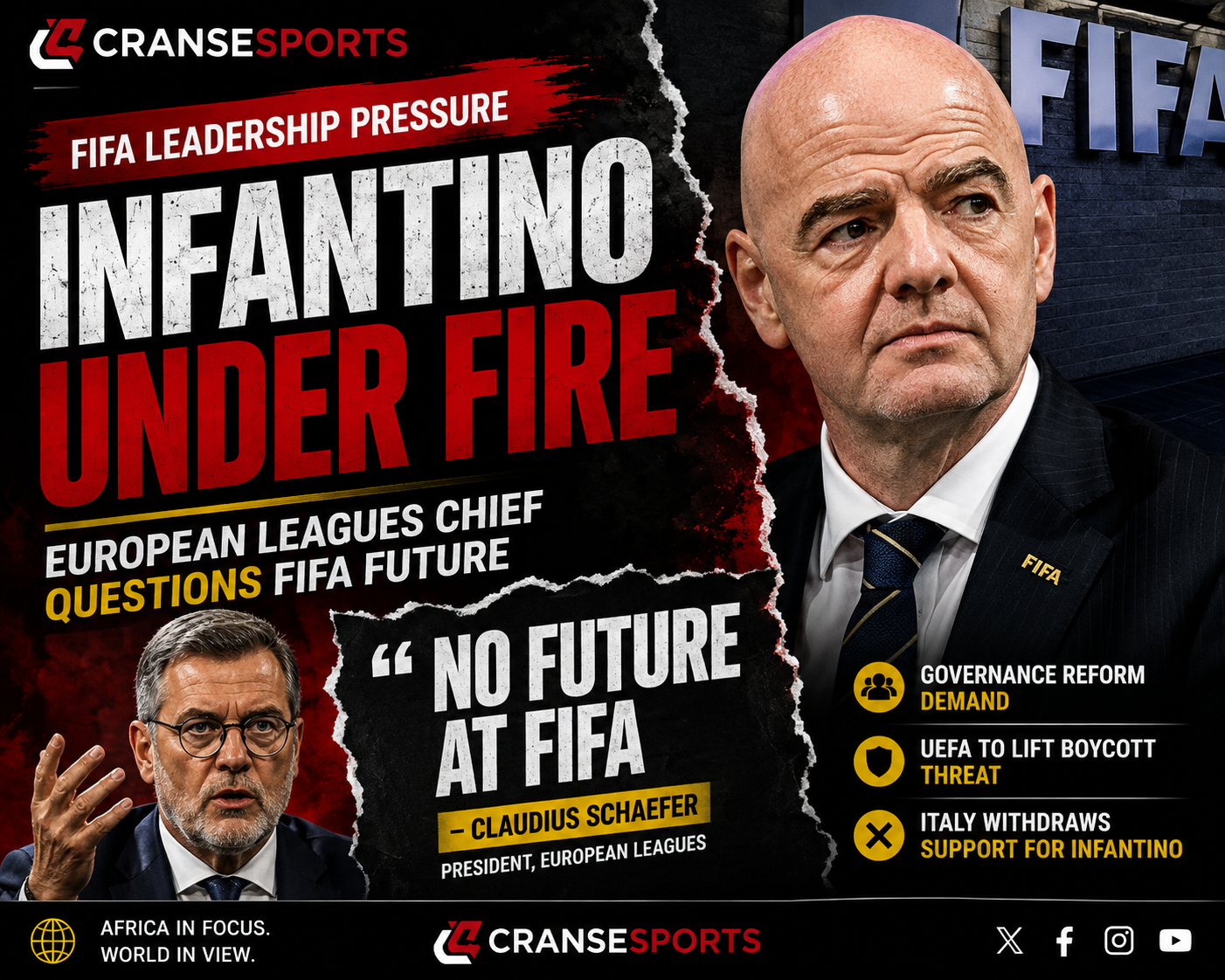
The pressure around Gianni Infantino is no longer confined to arguments over one FIFA decision. It is becoming a fight over whether he should continue leading world football at all.
European Leagues president Claudius Schaefer has publicly questioned Infantino’s suitability to remain FIFA president, arguing that the governing body needs reform and different leadership to deliver it. Schaefer told The Athletic, in comments subsequently reported by Reuters, that European Leagues is deeply concerned about how FIFA is being run and believes presidential influence has expanded at the expense of meaningful consultation with affected stakeholders.
His conclusion was stark: there could be “no future at FIFA for Infantino.” That is Schaefer’s position, not a formal FIFA decision.
But it lands inside an increasingly serious governance battle.
European Leagues represents 53 professional men’s and women’s leagues, giving Schaefer’s intervention institutional weight as tensions continue over FIFA decision-making, commercial control and the authority of the presidency.

The immediate confrontation has also shifted. UEFA is set to withdraw its threatened boycott of FIFA tournaments after receiving assurances that plans linked to the abandoned commercial-rights proposal will not return.
But the pressure on Infantino has not disappeared. Reuters has reported that Italy has withdrawn its support for the FIFA president, while wider concerns about his leadership and FIFA’s governance structure remain part of the dispute.
The easing of one boycott threat does not end the argument over how FIFA is governed.
The fight is now about FIFA power
Schaefer’s central complaint is not simply personal opposition to Infantino. It is that major decisions, in his view, have increasingly been taken without sufficient consultation with the leagues and institutions expected to absorb their consequences. That accusation strikes at the heart of FIFA’s own public defence.
FIFA has acknowledged that leadership processes, communication and interaction between the president, secretary general and management board can be improved. At the same time, the governing body has reaffirmed that Infantino continues to hold the mandate of FIFA’s 211 member associations and that any challenge to his presidency must operate through the organisation’s statutes and democratic procedures.
Critics see too much authority concentrated around the presidency. FIFA answers that Infantino’s legitimacy comes from its member associations and the governance system that elected him.

The next election is already part of the pressure
Infantino is not merely considering another run.
FIFA confirmed that he will stand for re-election in 2027, placing the present governance battle directly in the path of the next presidential contest. That raises the stakes around Schaefer’s intervention.
If the dispute becomes only a campaign against one individual, the argument can be reduced to personalities. If it becomes a fight over FIFA’s structures, consultation rules and presidential powers, the consequences could survive whoever eventually occupies the office.
For supporters, governing-body politics can feel distant from the pitch.
But decisions made inside FIFA shape competition structures, commercial rights, international calendars, development funding and the balance of power between FIFA, confederations, leagues and clubs.
He has not removed Infantino.
He cannot decide the FIFA president’s future by declaration.
But he has pushed one of world football’s biggest institutional arguments further into the open.
And with Infantino already committed to seeking another term in 2027, the next phase of the fight is no longer just about criticism.
It is about who still wants him leading when the vote comes.
Cranse Sports
News For Fans Who Read The Game
