


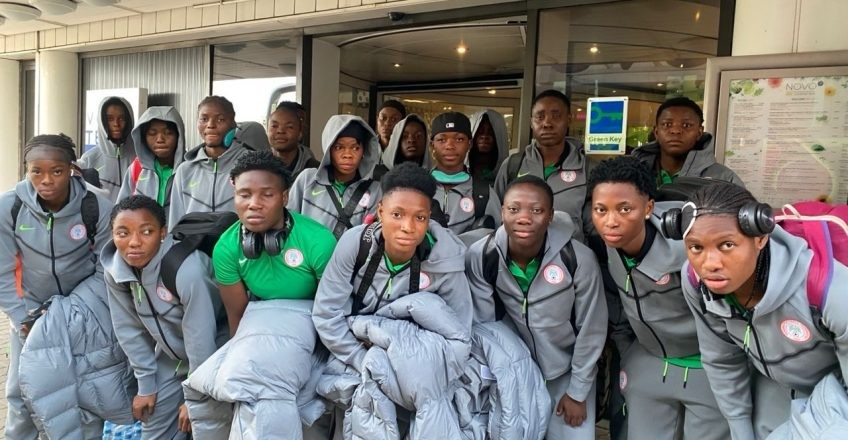
Nigeria arrive with momentum, belief and no reported injury concerns—but Spain’s early pressure, technical control and attacking depth make concentration non-negotiable.
There will be no gentle introduction to the FIFA U-20 Women’s World Cup for Nigeria’s Falconets.
Their campaign begins against Spain—the 2022 champions and one of the most technically developed teams in the competition—at Arena Sosnowiec on Monday.
Kick-off is scheduled for 5 p.m. WAT—6 p.m. in Poland.
Nigeria have travelled to Poland with history, confidence and ambition. But against Spain, reputation will offer no protection. The Falconets must prove immediately that they can impose themselves on a match without allowing emotion, physical effort or early pressure to pull their structure apart.
This is more than an opening fixture. It is the game that could shape who takes early control of Group F.

Group F Offers Opportunity—But Little Protection
Spain, Nigeria, China PR and tournament debutants New Caledonia make up Group F.
The top two teams in each group advance automatically to the Round of 16, alongside the four best third-placed sides. That format provides a possible recovery route, but it also places a premium on points, goal difference and disciplined game management.
A defeat against Spain would not eliminate Nigeria. It would, however, transfer greater pressure onto the remaining fixtures against China and New Caledonia.
A positive result would do the opposite: place the Falconets in control of their qualification route while forcing their rivals to respond.
Nigeria therefore cannot treat Spain as a prestigious match to be survived. They must approach it as an opportunity to seize the group.
Spain’s Warning Arrived in Seven Minutes
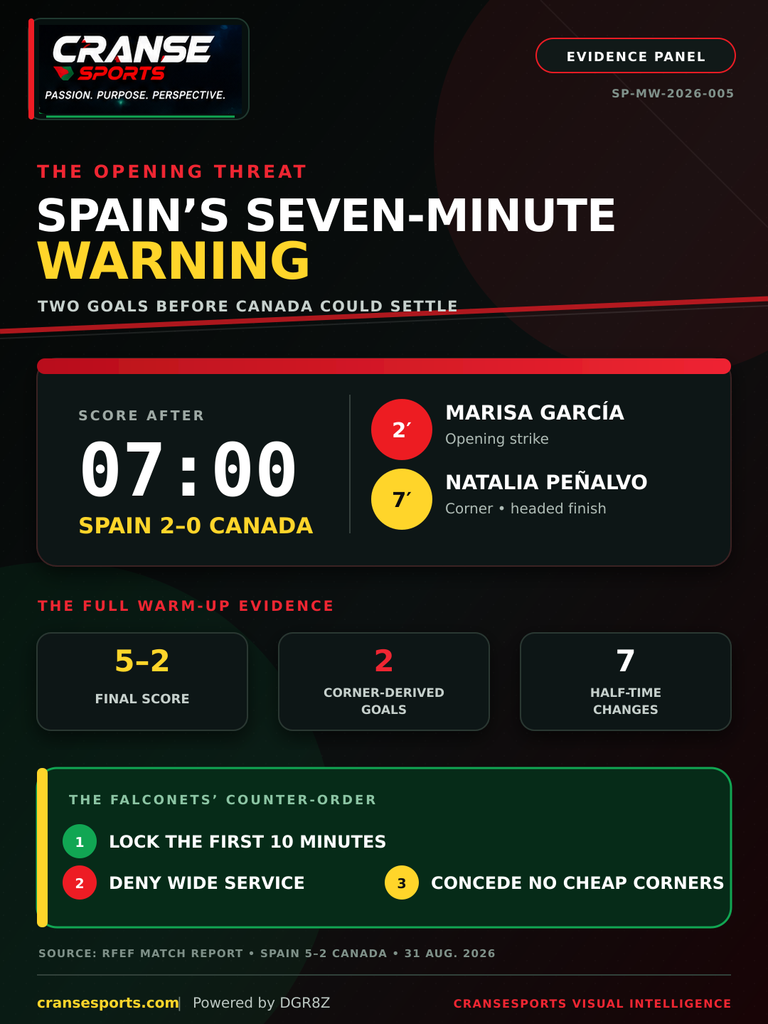
Spain supplied a sharp indication of their attacking threat when they defeated Canada 5–2 in a pre-tournament friendly in Poland.
David Aznar’s team scored after two minutes and struck again five minutes later. Their opening burst came through territorial control, pressure from the flanks and repeated set-piece situations.
Spain added a third before the half-hour mark and maintained their attacking output after making seven changes at half-time. That ability to alter personnel without surrendering control points to one of Nigeria’s central problems: Spain may possess enough depth to maintain their tempo beyond the opening phase.
The Falconets cannot afford to spend the first 15 minutes adjusting to the speed of Spain’s circulation.
They must disrupt the first pass, deny comfortable progression through midfield and prevent Spain’s wide players from receiving the ball while facing forward.
The danger is not merely Spanish possession. It is what that possession becomes when Nigeria’s defensive distances begin to stretch.
Nigeria Bring Their Own Evidence
The Falconets completed their preparations unbeaten.
They defeated hosts Poland 1–0 before drawing 1–1 with Korea Republic. Mary Mamudu scored both Nigerian goals, providing evidence that she can convert opportunities against international opposition.
Aduku reported after the Korea friendly that Nigeria had no injury concerns.
Those results should strengthen belief inside the Nigerian camp. They also exposed the detail that could define Monday’s contest.
Nigeria created chances against Korea but failed to finish enough of them. They then conceded a penalty in the 78th minute after leading for much of the match.
Against Spain, missed opportunities and failures in late-game control will carry a heavier price.
The Tactical Edge
The Falconets may not dominate possession, but they should still generate moments through physical pressure, recovery speed and direct attacking transitions. The question is whether they can turn those moments into goals before Spain re-establish control.
1. Break Spain’s First Rhythm
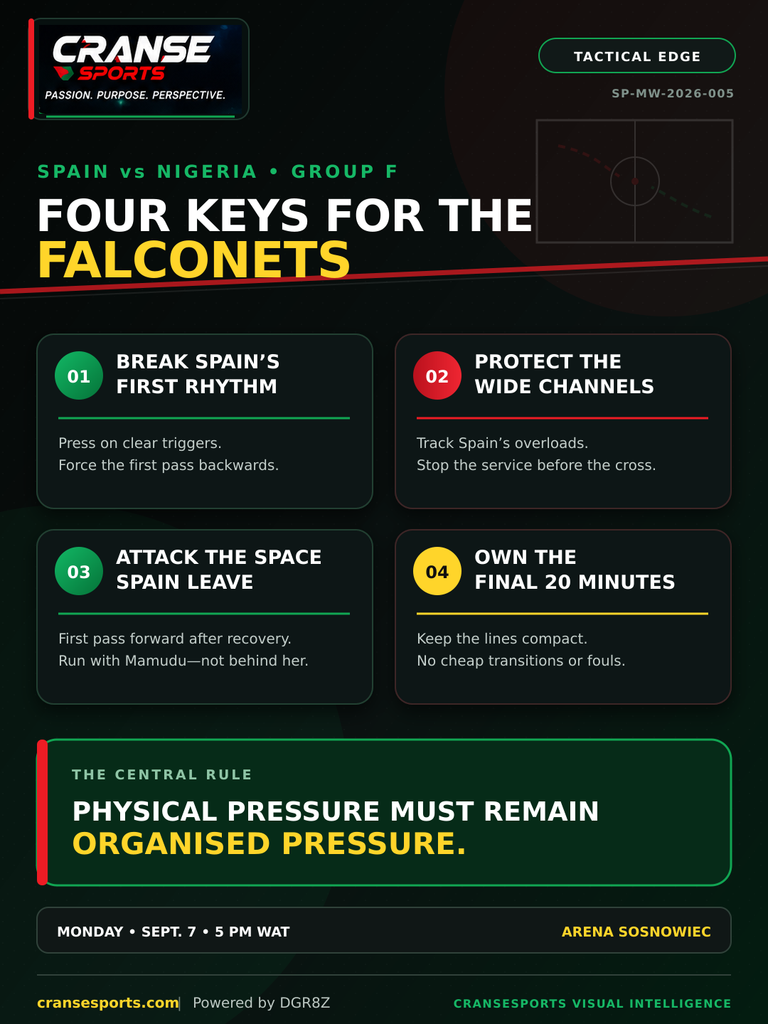
Nigeria must pressure with triggers rather than chase the ball indiscriminately.
The first backward pass, a poor touch near the touchline or a receiver collecting the ball with her back to goal should become the signal to press.
If one Falconets player jumps and the rest remain deep, Spain will play through the first challenge and attack an exposed midfield.
Physical pressure must remain organised pressure.
2. Protect the Wide Channels
Spain’s performance against Canada showed how quickly they can build pressure through the wings and convert corners into scoring opportunities.
Nigeria’s wide players must recover consistently, while the full-backs cannot be left defending two opponents in isolation.
Stopping the cross is preferable to defending repeated deliveries inside the penalty area.
Set-piece discipline will also be critical. Spain scored twice from corner situations against Canada, including one shortly after the second-half restart.
3. Attack the Space Spain Leave Behind
Spain will expect to hold the ball and push players into advanced positions. That creates Nigeria’s best attacking route.
The Falconets must play forward quickly after regaining possession. The first pass after the turnover should eliminate pressure—not return the ball to the area where it was won.
Mamudu’s recent scoring form gives Nigeria a focal point, but she will require runners around her. Isolated counterattacks will allow Spain to recover. Coordinated transitions can force their defenders to retreat towards their own goal.
4. Own the Final 20 Minutes
Nigeria’s late concession against Korea should be treated as a useful warning about game control.
The final phase against Spain will demand disciplined substitutions, compact defensive distances and emotional control. The Falconets cannot allow fatigue to turn the match into a collection of individual duels.
If they lead, they must still offer a counterattacking threat. If the scores are level, they must resist the temptation to abandon their structure in search of a dramatic winner.
A draw may feel conservative in the moment. In a difficult opening fixture, it could become a valuable tournament asset.
History Is Not the Destination
Nigeria have appeared at every edition of the FIFA U-20 Women’s World Cup and reached the final in 2010 and 2014.
That record establishes the Falconets as one of Africa’s most consistent youth teams. It also underlines the unfinished business surrounding the programme.
Nigeria have repeatedly reached the global stage. The next challenge is to convert consistency into a first world title.
Spain will test whether this Falconets side possesses the control required for that ambition.
Nigeria do not need to imitate Spain’s football. They need to make Spain uncomfortable, protect the dangerous spaces and punish the moments when possession becomes vulnerability.
The World Cup will not be won on Monday.
But the Falconets can make their first statement there.
