



The 21 Minutes That Killed Nigeria: How South Africa Punished the Super Falcons
For one moment, Nigeria were a header away from dragging themselves back into the fight.
Then the World Cup door slammed almost completely shut.
Uchenna Kanu rose to meet a cross in the 75th minute with the Super Falcons trailing South Africa 1-0 in Casablanca. Her header forced Kaylin Swart into a crucial save.
Nigeria had found the kind of moment that could have turned the entire match.
They never got another one like it.
Almost immediately, South Africa struck again.
Refiloe Jane reacted inside a crowded penalty area and drove an effort through bodies to make it 2-0.
Within a few brutal minutes, Nigeria had gone from threatening an equaliser to staring at elimination.
That swing explains this defeat better than the final score alone.
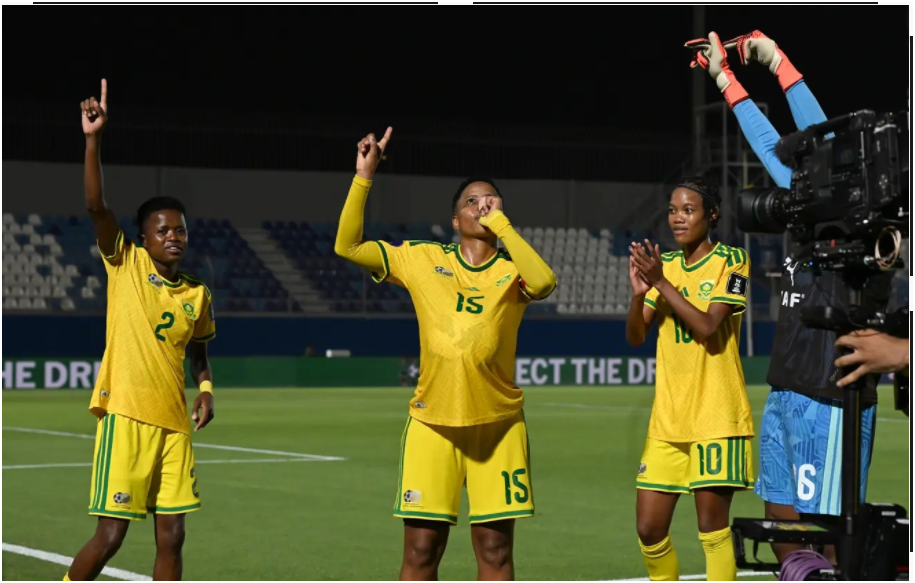
South Africa were waiting for the space
The first half had been tight.
Both teams fought for control without finding the breakthrough, and neither side managed to completely open the contest before the interval.
That changed in the 56th minute.
South Africa launched a rapid counterattack. Hildah Magaia supplied Thembi Kgatlana, who finished to put Banyana Banyana ahead.
The goal changed the pressure immediately.
Nigeria were no longer trying to manage a qualification playoff.
They were chasing it.
And once the game opened, South Africa carried a threat they were ready to use.
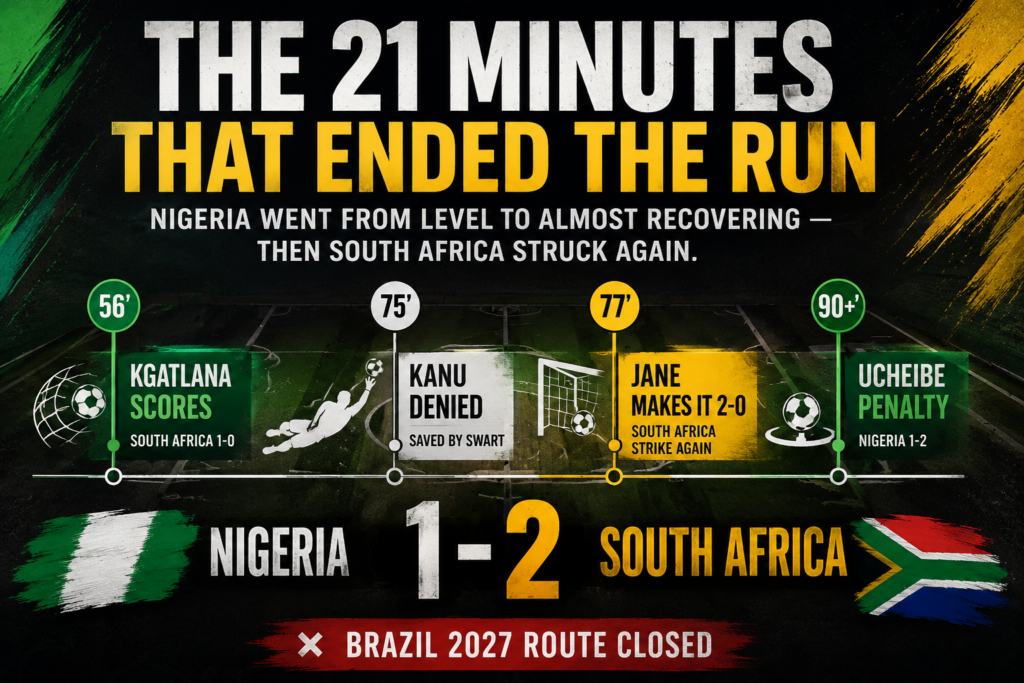
Nigeria found the response — but not the goal
The Super Falcons did not disappear after conceding.
They pushed for a way back and, in the 75th minute, came close enough for the entire match to feel as though it might turn.
Kanu attacked a cross and directed her header towards goal.
Swart made the save.
That was Nigeria’s pressure point.
Make it 1-1 there and the match changes completely.
South Africa are forced back into survival mode. Nigeria regain momentum. The closing stages become a fight for one decisive goal.
But the ball stayed out.
South Africa answered.
From almost 1-1 to 2-0
The cruelty of the sequence was its speed.
Nigeria had just forced South Africa into a major defensive intervention when Jane found space inside the area and struck for the second goal.
In the space of that decisive passage, Nigeria moved from believing they were close to recovery to facing a two-goal deficit.
This was the rupture.
The official match sequence supports a clear tactical conclusion: South Africa carried dangerous transition threat and punished Nigeria when the contest became stretched.
It does not require exaggeration.
There is no need to invent a formation failure, assign blame to one defender or claim Nigeria were comprehensively dominated.
The evidence is damaging enough.
South Africa managed the critical moments better.
Banyana Banyana did not need perfection
South Africa’s victory was not built on constant attacking pressure.
Their advantage came from patience, resistance and the ability to accelerate when the opportunity appeared.
They survived Nigeria’s strongest documented push for an equaliser.
Then they punished it.
That is the defining quality of high-pressure knockout football: surviving the opponent’s moment and making them pay for failing to take it.
Nigeria’s late goal changed the tension, not the outcome
The Super Falcons eventually scored.
Deep into stoppage time, a VAR review led to a penalty after Jane was penalised for handball. She received a second yellow card, reducing South Africa to 10 players, and Christy Ucheibe converted from the spot.
Nigeria pushed for one final equaliser.
It never came.
South Africa held on for a 2-1 win and advanced to the FIFA Women’s World Cup 2027 Play-Off Tournament.
Nigeria were out.
For the first time, a Women’s World Cup will go on without the Super Falcons.
Nigeria had appeared at every edition since the inaugural tournament in 1991 and entered this campaign carrying the weight of being African women’s football’s record champions.
That history makes the defeat enormous.
But the match itself turned on something much smaller.
A counterattack.
A saved header.
An immediate second goal.
Twenty-one minutes in which Nigeria went from level, to chasing, to almost recovering, to nearly out.
The final whistle ended the World Cup run.
The decisive damage had already been done.
