


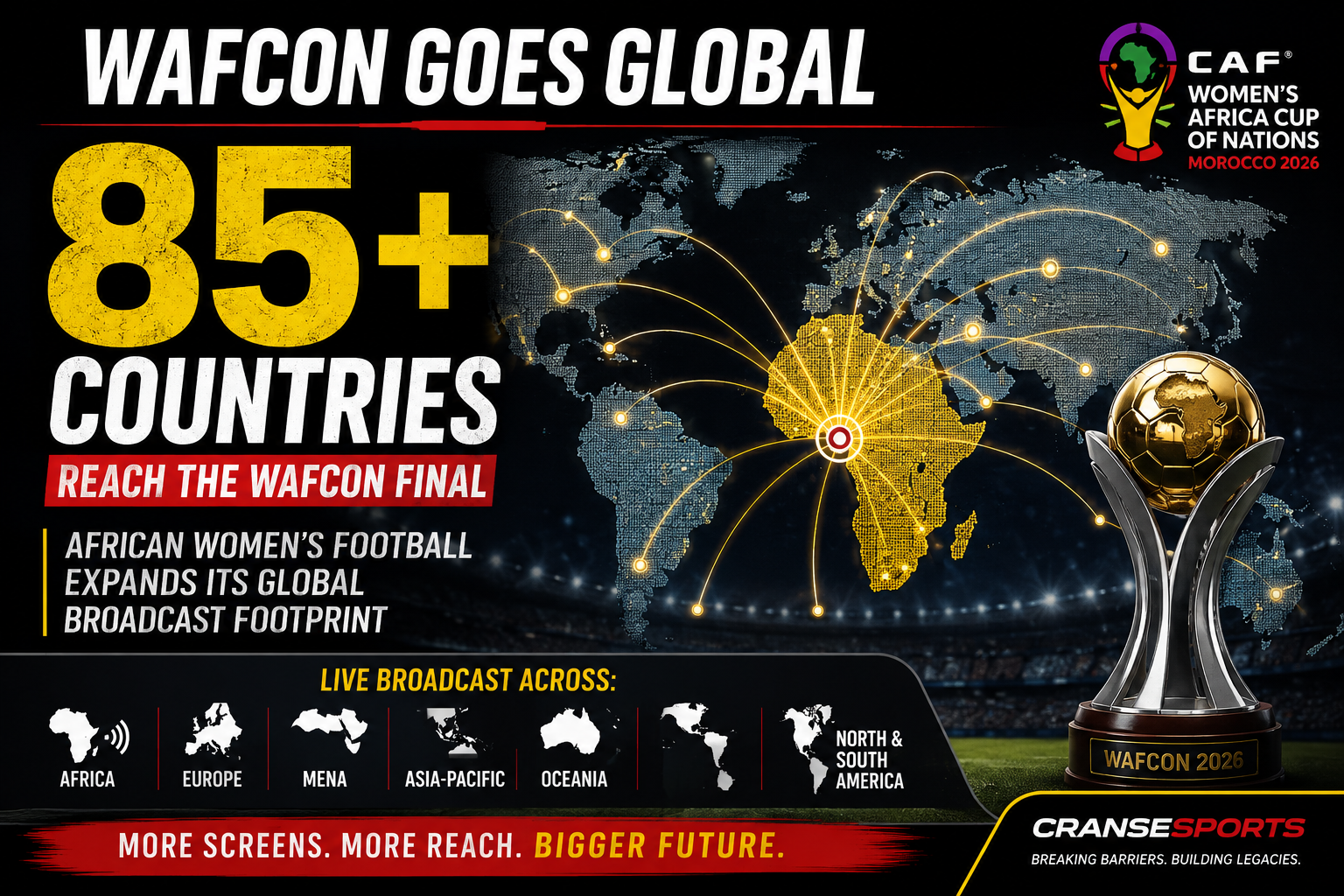
African women’s football is no longer fighting only for continental attention.
The 2026 Women’s Africa Cup of Nations final was made available live in more than 85 countries, pushing the competition into a wider international broadcast footprint across Europe, the Americas, Asia-Pacific, Oceania and Africa.
For WAFCON, that is more than a distribution statistic.
It is a signal of where the competition is trying to go.
CAF said the Cameroon–Malawi final entered first-time live broadcast territory in markets including the United Kingdom, Germany and Switzerland, while coverage also extended into parts of South America.
The broadcast network included major operators such as CANAL+, SuperSport and beIN Sports, alongside national and regional broadcasters across multiple markets.
Nigeria was part of that footprint too
AfroSport TV was listed among the broadcasters carrying the final in Nigeria, while other African markets had dedicated coverage through operators including SABC in South Africa, Azam TV in Tanzania and East Africa, KBC in Kenya, ZNBC in Zambia and Max TV in Ghana.
That continental base matters.
The global story means less if African audiences cannot consistently find the product at home.
But the 2026 distribution pattern shows CAF trying to do both: maintain continental reach while pushing WAFCON deeper into international television and streaming markets.
Earlier in the tournament, selected international audiences also gained access through CAF TV on YouTube, while DAZN carried matches in Germany, Austria and Switzerland.
The final widened that strategy.
Channel 4 carried the match free-to-air in the United Kingdom, while other partners extended coverage across Europe, MENA, Asia-Pacific, Oceania and North America.
The football gave broadcasters a historic product to carry.
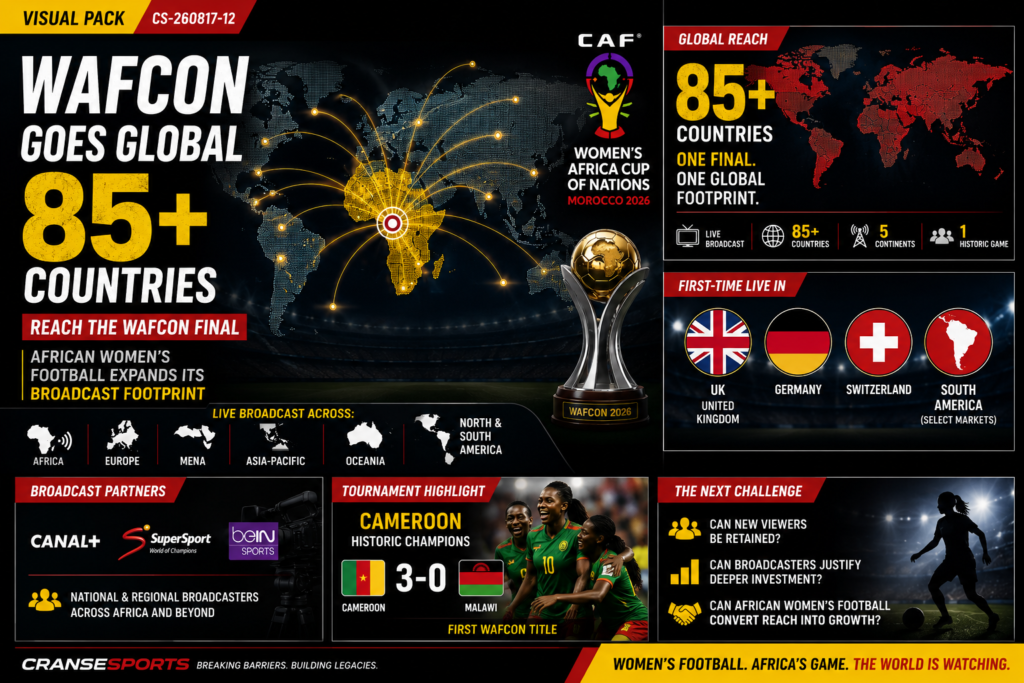
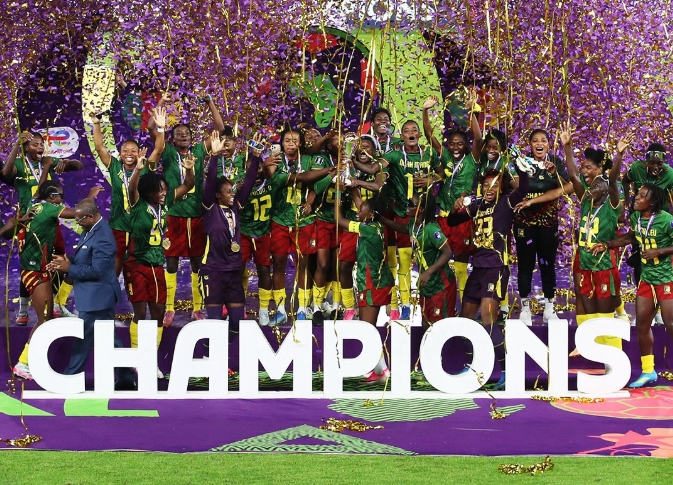
Cameroon beat Malawi 3–0 in Rabat to win their first WAFCON title, closing a tournament in which Malawi also reached the final on debut.
That combination a new champion, a new finalist and wider international distribution gives the 2026 edition significance beyond the trophy ceremony.
For years, one of the central commercial questions around African women’s football has been whether strong tournament moments can become repeatable audience products.
Broadcast expansion alone does not answer that
Being available in more than 85 countries does not automatically prove strong ratings, higher rights revenue, sponsorship growth or commercial profitability.
But distribution is still the gateway.
A competition cannot build international viewing habits in markets where viewers cannot find it. That is why the UK entry matters. That is why wider European coverage matters.
And that is why placing the final across Africa, North America, Asia-Pacific and South America matters.
The next challenge is retention.
Can new viewers be brought back for the next WAFCON?
How do broadcasters justify deeper coverage before the closing stages?
Can African women’s football turn wider access into stronger sponsorship, rights and digital products?
Those are now the harder questions.
For Nigeria, there is another layer
The Super Falcons did not reach the final, but Nigerian audiences remained inside the tournament’s broadcast ecosystem while Cameroon, the team that eliminated Nigeria, went on to lift the trophy.
That means WAFCON’s expanding international platform also raises the stakes for Nigeria’s future campaigns.
The 2026 final supplied the number:
More than 85 countries.
The harder challenge begins after that.
Reach gets African women’s football onto more screens.
Growth will be measured by how many of those screens come back.
Cranse Sports
News For Fans Who Read The Game
