


NFF Opens Probe as Super Falcons’ World Cup Failure Pushes Nigerian Football Into Reckoning
Nigeria’s latest football failure has moved beyond disappointment.
It is now officially under investigation.
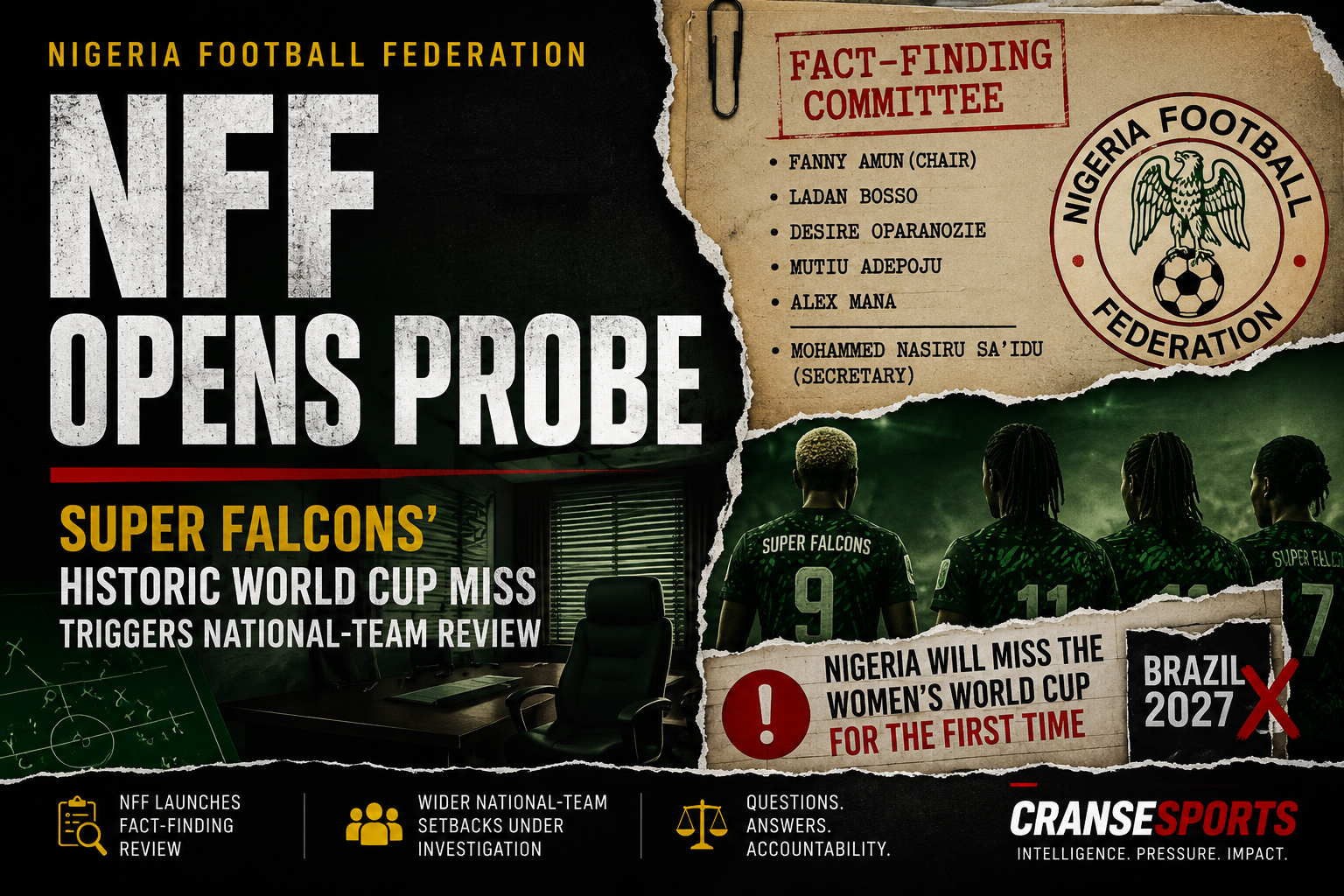
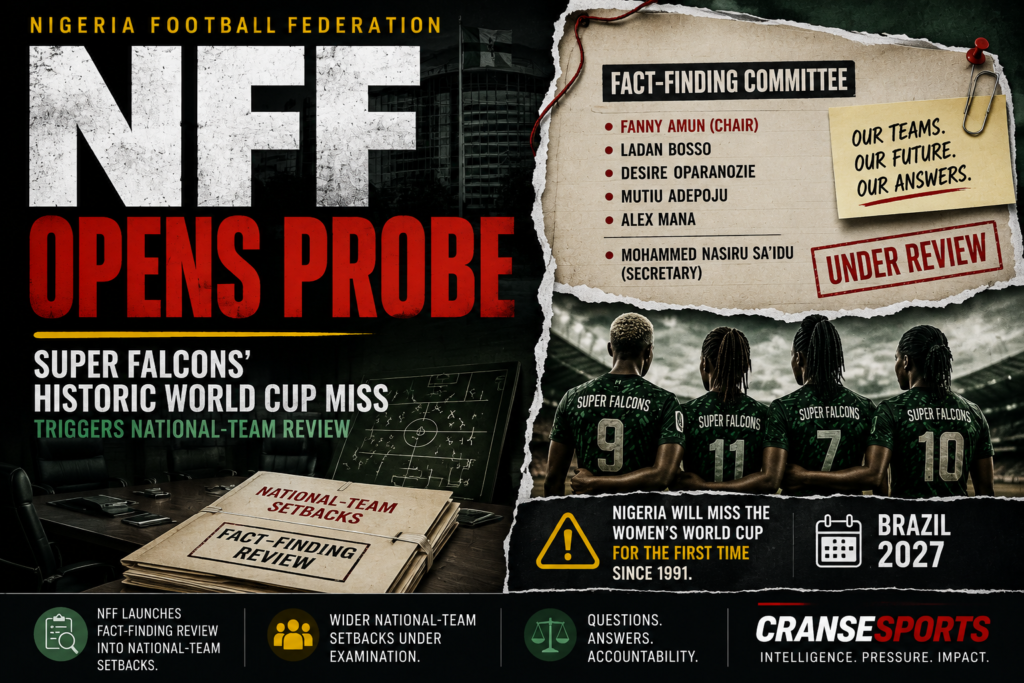
The Nigeria Football Federation has set up a fact-finding committee to examine what it described as the poor run of the country’s national teams, placing particular attention on the Super Falcons’ failure to qualify for the 2027 FIFA Women’s World Cup in Brazil.
Former NFF General Secretary Fanny Amun will chair the committee.
The panel also includes former Flying Eagles coach Ladan Bosso, former Super Falcons captain Desire Oparanozie, former Super Eagles captain Mutiu Adepoju and former FIFA referee Alex Mana.
Sokoto State Football Association chairman Mohammed Nasiru Sa’idu will serve as secretary.
The names matter.
But the larger question is what the committee is prepared to confront.
Because Nigeria are no longer dealing simply with a bad tournament.
They are dealing with a historic rupture.
Falcons Failure Changes the Scale of the Crisis
The Super Falcons will miss the Women’s World Cup for the first time since the competition began in 1991.
South Africa ended Nigeria’s final qualification route with a 2–1 victory, sending Banyana Banyana forward while ending the Super Falcons’ uninterrupted record of appearing at every Women’s World Cup.
Thembi Kgatlana put South Africa ahead before captain Refiloe Jane doubled the advantage.
Christy Ucheibe converted a stoppage-time penalty after Jane was sent off, but Nigeria could not find the equaliser needed to keep their World Cup hopes alive.
That defeat followed an earlier blow.
Nigeria entered the 2026 Women’s Africa Cup of Nations as defending champions and record 10-time winners, but Cameroon eliminated them 1–0 in the quarter-finals.
The loss to South Africa then shut the final escape route.
For a team that had appeared at every Women’s World Cup, the consequence is impossible to disguise.
Brazil 2027 will happen without Nigeria.
From Title Defence to Investigation
The collapse is sharper because of what the NFF itself expected only weeks earlier.
At its Executive Committee meeting on 11 July, the federation publicly challenged the Super Falcons to qualify for the World Cup, retain the WAFCON title and claim an 11th continental crown.
Neither target survived August.
Cameroon ended the title defence.
South Africa ended the World Cup run.
Now the federation that set those ambitions has appointed a committee to find out what went wrong.
That moves the story from the pitch to the institution.
Fanny Amun’s Committee Carries a Bigger Burden
A fact-finding committee can identify failures.
The real test will be whether those findings produce decisions.
Amun brings substantial administrative experience as a former NFF General Secretary.
Around him are figures drawn from different areas of Nigerian football: coaching through Bosso, elite women’s football through Oparanozie, former international experience through Adepoju and refereeing through Mana.
That gives the committee breadth.
It also creates expectation.
The NFF has made clear that the exercise concerns wider national-team setbacks rather than only the Falcons.
But the federation’s own announcement gives particular attention to the senior women’s team’s failure to reach the World Cup.
The committee therefore enters a difficult space.
Was preparation sufficient?
Were selection and technical structures good enough?
Were logistics and federation support adequate?
And once the answers arrive, who acts on them?
Those questions will determine whether this becomes a genuine reset or simply another review produced after a damaging result.
Nigeria Have Heard Review Promises Before
The pressure on the federation is intensified by recent history.
After the Super Eagles failed to qualify for the 2026 FIFA World Cup, the NFF apologised publicly and said its board and management would conduct a rigorous review of the technical, administrative and structural shortcomings behind that failure.
Now another senior national team has missed another World Cup.
That does not mean the causes are identical.
But it raises the stakes around this latest inquiry.
Nigeria cannot afford for “review” to become the final response rather than the beginning of corrective action.
What Happens Next Matters More Than the Committee List
The Falcons’ elimination is already settled.
No committee can restore the World Cup ticket.
What the NFF can still determine is whether the failure changes how Nigeria prepare, select, manage and support their national teams going forward.
That is where this story now lives.
Not simply in who sits on the panel.
But in what the panel finds, what the federation accepts and what actually changes afterward.
Nigeria’s most successful senior football team has fallen out of a World Cup for the first time.
The investigation has begun. The harder part will be proving that Nigerian football has learned anything from the fall.
