



The crown is gone.
Now Nigeria have to stop the World Cup dream going with it.
The Super Falcons face South Africa in Casablanca on Thursday after both African heavyweights lost their WAFCON quarter-finals and were pushed into the longer qualification route for the 2027 FIFA Women’s World Cup. CAF confirms that the eliminated quarter-finalists remain alive through play-off matches scheduled for August 13.
For Nigeria, this is no longer about defending continental supremacy.
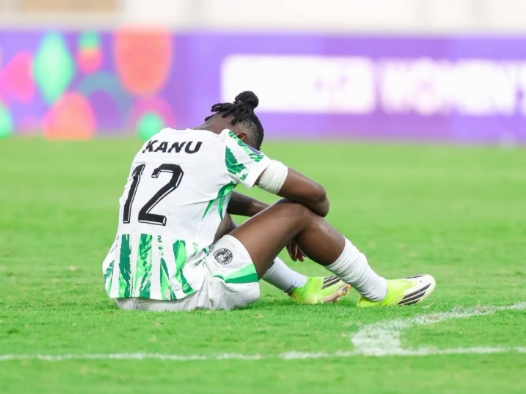
It is survival.
Cameroon beat Justin Madugu’s side 1-0 in the quarter-finals despite sustained Nigerian pressure. The NFF says that defeat left the Super Falcons facing South Africa for a place in the inter-continental World Cup play-off.
South Africa arrive carrying their own damage after a 2-1 defeat to Morocco.
But Banyana Banyana also arrive with a warning.
They do not disappear when a match begins moving against them.
And with Thembi Kgatlana available as one of their major attacking threats, Nigeria cannot afford to chase the breakthrough and forget what is waiting behind them.

Nigeria’s first problem: pressure must become penetration
Against Cameroon, Nigeria had territory.
They had attacking waves.
They had possession in dangerous areas.
What they did not have was the goal.
The NFF’s match report records Gift Monday and Jennifer Echegini threatening before Madugu introduced Uchenna Kanu and later Toni Payne, Esther Okoronkwo and Asisat Oshoala as Nigeria searched for an equaliser. Cameroon survived everything.
That is the first tactical problem South Africa will study.
Nigeria cannot measure their attack by how long they spend around the penalty area.
They have to measure it by what they create inside it.
The ball needs to move faster around an organised defence.
Runs need to threaten space behind the line rather than always arriving to feet.
Wide attacks need to produce cut-backs, combinations and clear targets instead of becoming predictable delivery.
Nigeria do not simply need more attacks.
They need better ones.
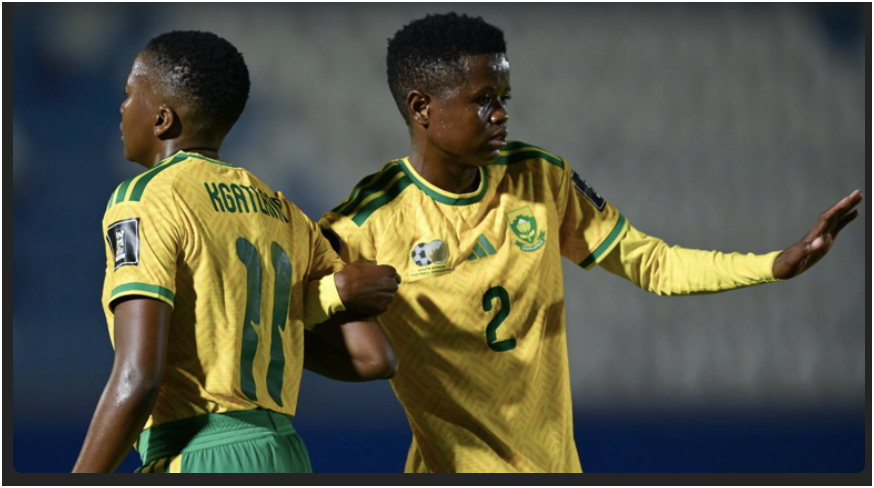
Kgatlana is the transition alarm
South Africa showed against Morocco that they can remain dangerous after losing control of a knockout match.
Kgatlana scored to reduce a two-goal deficit, and SAFA reported that Desiree Ellis’ side then pushed Morocco deep during the closing stages. Ellis said her team had periods of control and refused to stop fighting.
That creates the most obvious danger for Nigeria.
The more players the Falcons commit forward, the more valuable the space behind them becomes.
Kgatlana does not need Nigeria to give her many openings.
One clean transition may be enough.
So Nigeria’s defensive work begins the moment an attack breaks down.
The nearest midfielder has to slow South Africa’s first pass.
The defensive line cannot be left running backwards against space.
And frustration after a missed chance cannot become tactical disorder.
The question is simple:
Can Nigeria chase the goal without giving Kgatlana the game she wants?

Ajibade has to hurt South Africa where it matters
Rasheedat Ajibade remains one of Nigeria’s central attacking figures.
But against South Africa, influence alone will not be enough.
Nigeria need their captain receiving in positions where she can force defensive decisions — close enough to drive inside, combine with runners or attack the penalty area.
If Banyana can keep Ajibade too deep or too wide against a settled defensive block, Nigeria risk repeating the same pattern that hurt them against Cameroon: plenty of attacking possession without enough damage.
The objective should be isolation.
Get Ajibade against one defender.
Make South Africa send help.
Attack the space that creates.
Madugu has a low-block problem to solve
Cameroon have already supplied part of the blueprint.
Protect the box.
Deny Nigeria clean central access.
Stay organised.
Then make the Falcons prove they can break you.
South Africa do not have to reproduce Cameroon’s approach exactly, but Nigeria should expect periods where patience and invention matter more than raw urgency.
That demands variation.
Switch the point of attack.
Create overloads.
Attack the space behind defenders.
Use cut-backs when the box becomes crowded.
And if the match begins to freeze, change the attacking picture before desperation becomes the tactical plan.
This is where Madugu comes under pressure.
Nigeria cannot afford another match in which substitutions increase attacking numbers without increasing attacking clarity.
South Africa know how to stay alive
Banyana’s quarter-final defeat should not be mistaken for surrender.
South Africa went 2-0 down to Morocco before Kgatlana pulled one back, and Ellis said her players continued forcing the hosts backwards late in the contest.
That resilience matters because this match could become psychologically dangerous for Nigeria.
If the score remains level deep into the second half, the pressure will not be shared equally.
Nigeria will feel the demand to force the result.
South Africa may feel the opportunity to wait for the error that pressure creates.
The Falcons therefore need urgency without panic.
Ajibade against the block. Kgatlana against the space.
Those may be the two battles that define the night.
Nigeria need Ajibade and their attacking unit to disorganise South Africa before anxiety takes over.
South Africa need to stay alive long enough for Kgatlana and their transition game to find room.
Then there is the coaches’ battle.
Madugu must find a cleaner attacking solution after Cameroon.
Ellis must build on a South African side that showed against Morocco that it can absorb damage and keep coming.
History gives Nigeria confidence — not protection
Nigeria have reason to believe they can beat South Africa.
But history will not solve Thursday’s tactical problems.
It will not create the first opening.
It will not stop Kgatlana on the break.
And it will not turn possession into a goal.
The latest result is what matters most now: Nigeria lost 1-0 to Cameroon, South Africa lost 2-1 to Morocco, and both have been pushed outside the automatic World Cup places.
That makes this a different kind of Nigeria–South Africa collision.
Not a group game.
Not a prestige friendly.
Not even a conventional knockout match.
This is a fight to keep the qualification route open.
The first goal could control the night
Nigeria scoring first would change South Africa’s options.
Banyana would have to take greater attacking risks, potentially opening the spaces the Falcons have struggled to create against compact defences.
South Africa scoring first produces the nightmare scenario.
Nigeria would be forced forward against a team capable of attacking the space left by urgency.
That makes the opening period about more than aggression.
Nigeria need authority.
Move the ball.
Move South Africa.
Find the right opening.
And when possession disappears, protect the spaces that can destroy the entire plan.
Break the block. Stop the break. Save the World Cup.
This is no longer about Nigeria’s WAFCON crown.
Cameroon already took that away.
Now the Falcons are fighting for the road to Brazil.
Ajibade carries the attacking responsibility.
Kgatlana carries South Africa’s counter-attacking warning.
Madugu needs answers after a quarter-final in which pressure never became a goal.
Ellis has a side that has already shown it will keep fighting when a knockout game turns ugly.
One team leaves Casablanca with another World Cup battle ahead.
The other leaves with the road closed.
Nigeria need to break South Africa’s resistance.
They also need to survive what comes back at them.
Break the block. Stop the break. Save the World Cup.
