


Zambia Won but Still Went Home — Häuptle’s WAFCON Exit Opens a CAF Tie-Break Debate
Zambia did what teams fighting elimination are supposed to do.
They won.
And then they went home.
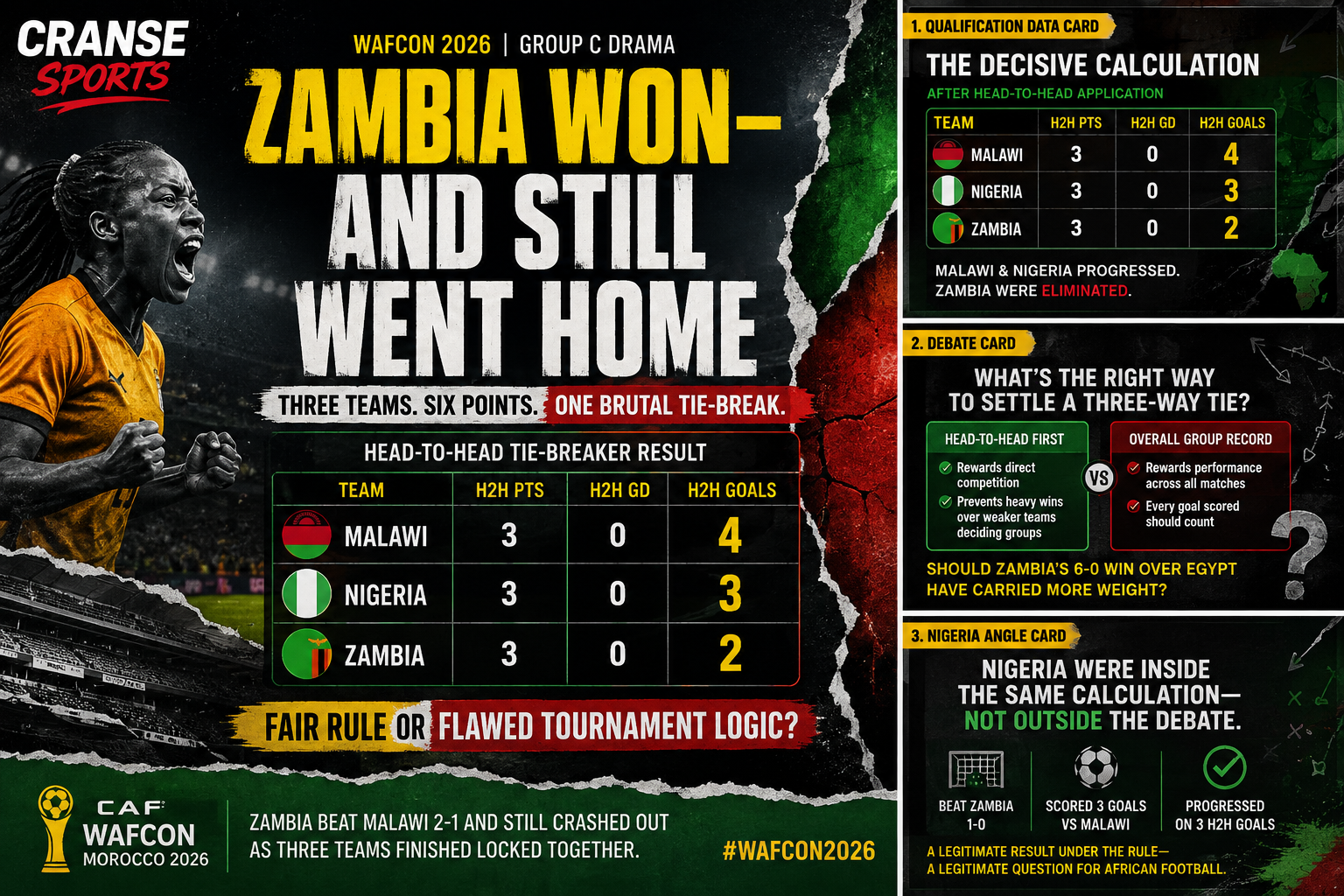
The Copper Queens beat Malawi 2-1 in their final WAFCON Group C match, yet Malawi advanced to the quarter-finals alongside Nigeria as a three-team tie turned Zambia’s tournament into a debate about the rules themselves. CAF’s current tournament record confirms Malawi progressed despite the defeat.

For Zambia coach Nora Häuptle, the argument is not simply about losing a qualification battle.
It is about what a competition should value when teams finish locked together.
Three teams, six points — and nowhere to hide
The pressure had been building from the opening round.
Malawi stunned defending champions Nigeria 3-2. Nigeria responded by beating Zambia 1-0, with Asisat Oshoala scoring the decisive goal before the Super Falcons protected the lead with 10 players. Zambia had already announced themselves with a 6-0 victory over Egypt.
Then came Zambia’s 2-1 win over Malawi.
The result left Nigeria, Malawi and Zambia caught in the decisive three-team calculation.
Once only their matches against one another were considered, all three had three points and a goal difference of zero.
Goals scored in those mutual games became decisive:
| Team | H2H points | H2H goal difference | H2H goals |
|---|---|---|---|
| Malawi | 3 | 0 | 4 |
| Nigeria | 3 | 0 | 3 |
| Zambia | 3 | 0 | 2 |
Zambia were out.
CAF’s official archive confirms the Nigeria-Malawi and Nigeria-Zambia results that drove that calculation.
Why Zambia’s 6-0 win stopped mattering
That is the part of the system likely to fuel the strongest argument.
Zambia’s six-goal demolition of Egypt demonstrated their attacking power across the wider group. But once the three-way head-to-head calculation became decisive, that result no longer separated Zambia from Nigeria and Malawi.
This is where two competing ideas of sporting fairness collide.
One argument says tied teams should first be judged by what happened when they faced each other. That prevents a qualification race being distorted by which team happened to inflict the heaviest defeat on the weakest side in the group.
The alternative says the group stage should be judged as a complete body of work. Every match, every goal scored and every goal conceded should continue to matter.
Zambia’s elimination shows the difference between those philosophies is not academic.
It can decide who stays in a major tournament and who goes home.
The regulation question needs precision
The multi-team sequence applied in Group C mirrors the mechanism contained in Article 71.2 of the Women Africa Cup of Nations regulations currently published by CAF: points between the tied teams, followed by goal difference and goals scored in those matches.
There is, however, an important distinction.
The document currently surfaced by CAF is explicitly labelled Edition 2020, while the 2026 tournament features 16 teams and four groups. CAF’s own current competition material confirms the expanded 2026 field.
That means the rule sequence can be compared with the mechanism actually applied without presenting the 2020 publication as a separately issued 2026 rulebook.
The controversy is therefore not evidence, on the available authority record, that CAF secretly altered or improperly applied its regulations.
The sharper question is whether the system itself produces the best sporting outcome.
Nigeria are not spectators in this argument
This debate matters directly to Nigerian football.
The Super Falcons did not merely watch Zambia suffer under a distant administrative rule. Nigeria were one of the three teams inside the calculation.
Their 1-0 victory over Zambia became crucial. So did the three goals they scored in defeat against Malawi. Those results ultimately placed Nigeria between Malawi and Zambia in the head-to-head goals column.
Nigeria’s progression is therefore legitimate under the mechanism CAF applied.
But that does not make the argument irrelevant.
If anything, it makes the debate more useful: African football can examine whether a rule produces the right competitive incentives without pretending that the team which benefited did something wrong.
A clear rule can still create an uncomfortable result
That is the real pressure point left behind by Zambia.
Tournament regulations do not need to malfunction before they deserve scrutiny.
A head-to-head system rewards direct competition between tied teams. An overall-goal-difference system rewards performance across the entire group. Both have a sporting logic.
What happened in Group C forced those philosophies into the open.
Zambia scored heavily across the group, won their final match and were still eliminated because the decisive calculation became narrower than the full table.
Nigeria and Malawi moved on.
The Copper Queens did not.
And that is why Häuptle’s challenge is likely to outlive Zambia’s WAFCON campaign.
A rule can be clear, correctly applied and still leave African football asking whether it produced the fairest result.
