


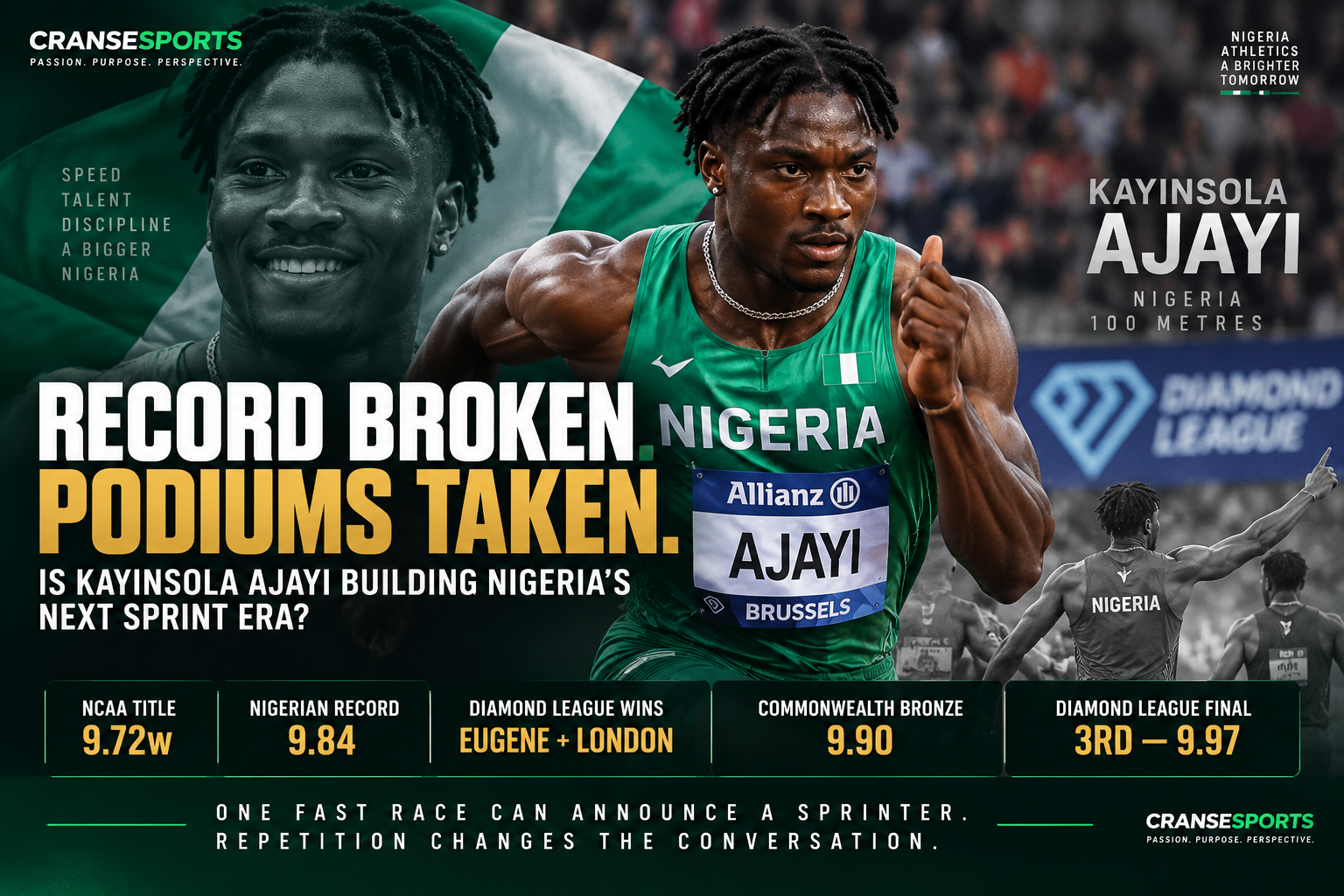
Record Broken. Podiums Taken. Is Kayinsola Ajayi Building Nigeria’s Next Sprint Era?
Kayinsola Ajayi finished third in the Diamond League Final in Brussels in 9.97 seconds, adding another elite result to a season already featuring a Nigerian record, Diamond League victories and Commonwealth bronze. One fast race can announce a sprinter. Ajayi’s 2026 is beginning to show something more important — repetition.
Brussels Was Not the Breakthrough — It Was Confirmation
Kayinsola Ajayi did not need Brussels to prove that 2026 had changed his career.
But finishing third in the Diamond League Final in 9.97 seconds gave the season another piece of evidence.
Jamaica’s Oblique Seville won in 9.90.
Cameroon’s Emmanuel Eseme followed in 9.93.
Ajayi crossed next.
Third place.
Another sub-10-second performance.
Another elite field.
Another result that belonged beside the others rather than standing alone.
That distinction matters.
One fast race can announce a sprinter. What changes perception is repetition.
And Ajayi is beginning to produce enough of it that the conversation around Nigerian men’s sprinting has to become more serious.
9.84 Changed Nigeria’s Sprint Standard
The season’s defining number remains 9.84 seconds.
Ajayi ran it legally in Lexington in May, moving ahead of Olusoji Fasuba’s long-standing 9.85 and becoming Nigeria’s fastest man ever over 100 metres on the all-time list.
For years, Fasuba’s mark stood as one of Nigerian athletics’ most durable reference points.
Breaking it changed Ajayi’s status immediately.
He was no longer simply another promising Nigerian sprinter running fast times on the American collegiate circuit.
He had crossed into national-record territory.
That creates opportunity.
It also creates pressure.
Because once a national record falls, the conversation changes from potential to expectation.
The next question becomes unavoidable.
Can the athlete repeat that level when the stakes rise?
Ajayi’s answer across the rest of 2026 has increasingly been yes.
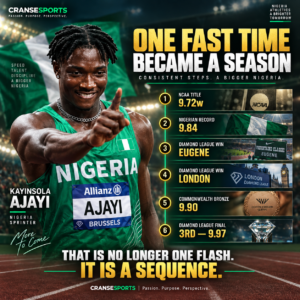
One Fast Time Became a Season
Ajayi did not disappear after Lexington.
He reproduced 9.84 later in the season and won Diamond League races in Eugene and London, placing himself repeatedly among the fastest men on the international circuit.
That matters more than a single headline performance.
Elite sprinting is unforgiving.
Margins are tiny.
Fields are deep.
And a career cannot be built around one personal best.
The sprinters who stay relevant are the ones who can keep returning to finals, keep surviving rounds and keep running quickly when conditions and competition change.
Ajayi’s 2026 campaign has started to show those qualities.
Not perfectly.
Not conclusively.
But repeatedly.
That repetition is what is beginning to turn a breakthrough into a body of work.
Commonwealth Bronze Added Championship Proof
Fast circuit times answer one question.
Championship races answer another.
At the Commonwealth Games in Glasgow, Ajayi ran 9.90 seconds to take bronze in the men’s 100m.
Eseme won.
Lachlan Kennedy finished second.
Ajayi came through in third.
That result matters because championship sprinting operates differently from a one-off circuit race.
Athletes have to manage rounds.
Control nerves.
Execute under the weight of medals rather than ranking points.
A personal best does not guarantee anything once eight finalists settle into their blocks.
Ajayi left Glasgow with a medal.
For Nigeria, that added something his season needed.
Proof that the speed could survive a championship environment.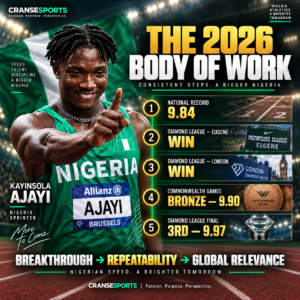
The Diamond League Final Raised the Ceiling Again
Then came Brussels.
Ajayi did not win.
He did not produce his fastest time.
He did something else that matters.
He finished on the podium at the Diamond League Final.
Multiple Nigerian reports have identified the result as the first men’s 100m Diamond League Final podium by a Nigerian athlete.
That historical designation should retain its attribution, but the significance of the performance itself is clear.
The Diamond League Final gathers athletes who have survived an elite international season.
There are few places for passengers.
Ajayi reaching that stage and finishing third reinforces the most important conclusion from his year:
He belongs in these races.
That does not mean he will win every one.
It does not mean World Championship or Olympic medals are guaranteed.
But it means the expectation has moved.
Do Not Crown Him Yet — But Do Not Ignore the Evidence
This is where perspective matters.
Nigeria has a habit of turning athletic breakthroughs into coronations too quickly.
Ajayi has earned excitement.
He has not earned exemption from the normal demands of elite sprinting.
He is not Africa’s fastest man on 2026 legal times.
Eseme has run faster.
Ajayi is not yet a global-championship medal certainty.
And one exceptional season does not automatically become a long career.
There are still questions.
Can he stay healthy?
Can he improve his start?
Can he consistently reproduce his best speed across championship rounds?
Can he handle the expectation that comes with being Nigeria’s national-record holder?
Can he convert Diamond League competitiveness into World Championship and Olympic medals?
Those are not reasons to minimise what he has done.
They are the next measurements.
Nigeria May Finally Have a Sprint Arc Worth Building Around
The wider Nigerian question is bigger than Ajayi’s personal medals.
For a country with deep sprint history, sustained elite men’s 100m relevance has often proved difficult to maintain.
There have been moments.
Fast athletes.
Promising seasons.
But what Nigerian athletics needs is not another isolated breakthrough.
It needs continuity.
Athletes capable of staying near the front of the global conversation across multiple seasons.
Ajayi’s 2026 has created the possibility of that.
Consider the progression:
NCAA title.
Wind-assisted 9.72.
Legal Nigerian record — 9.84.
Diamond League victories.
Commonwealth bronze.
Diamond League Final podium.
That is no longer one flash.
It is a sequence.
And sequences are where careers begin to acquire shape.
2027 Will Tell Us Whether This Was the Peak or the Beginning
Every breakthrough season eventually has to answer what comes next.
The times get harder to improve.
Opponents adjust.
Expectation rises.
The athlete is no longer surprising anybody.
Ajayi will enter the next phase of his career with a different burden.
He will no longer merely be one of Nigeria’s promising sprinters.
He will be the national-record holder.
A Diamond League winner.
A Commonwealth medallist.
A Diamond League Final podium finisher.
That is a different status.
And it demands a different level of consistency.
Brussels therefore should not be treated as the end of a remarkable season.
It should be treated as a checkpoint.
Because Nigeria has already seen enough to know Kayinsola Ajayi is fast.
The next question is more important.
Can he remain this good long enough to build an era?
One season cannot answer that.
But 2026 has earned him the right to be asked.
The record has fallen.
The podiums are arriving.
Now Nigeria waits to see whether Kayinsola Ajayi is building something that lasts.
