



Korea Already Showed Nigeria Where the Cracks Were
D’Tigress arrive at the FIBA Women’s Basketball World Cup with the profile of a team nobody should underestimate.
They are Africa’s dominant women’s basketball force.
They reached the quarter-finals of the Paris 2024 Olympics.
They won another AfroBasket crown in 2025.
They sit eighth in the FIBA world rankings.
And yet the first opponent waiting for them in Berlin carries an uncomfortable reminder of how little continental reputation guarantees at the highest level.
Korea beat Nigeria 77–60 in March.
The defeat came during the World Cup qualifying tournament in Villeurbanne, France, and it was not a last-possession escape.
Nigeria started brightly, but Korea overturned that early advantage, moved ahead for good and eventually pulled away for a 17-point victory.
Park Jihyun led Korea with 22 points.
Nigeria walked away with a 17-point defeat.
Now, less than six months later, the same teams meet again — except this time there is no qualifying cushion around the result.
This one opens the World Cup.

Africa’s Champions Now Have to Prove It Globally
There is a temptation whenever D’Tigress enter a major tournament to begin with what they have done in Africa.
That record deserves respect.
But Berlin demands a different question.
What can Nigeria now become globally?
FIBA describes Nigeria as a team standing on the edge of another potential breakthrough after their historic Olympic quarter-final run in Paris.
Their best Women’s World Cup finish remains eighth place in 2018, and a top-seven finish in Germany would establish a new Nigerian benchmark on the global stage.
That changes the expectation.
Nigeria are no longer travelling simply to prove an African team belongs among the elite.
Paris helped settle that argument.
Berlin is about whether D’Tigress can make deep international tournament runs something repeatable rather than exceptional.
And Korea present the first examination.
The Qualifiers Left a Warning Nigeria Cannot Ignore
D’Tigress qualified for the World Cup as 2025 African champions, but they still took part in the March qualifying tournament.
The results were revealing.
Nigeria beat Colombia 70–37.
They lost 77–60 to Korea.
They responded by defeating the Philippines 101–84.
Then came defeats to France, 93–86, and Germany, 81–73.
The overall record was two victories and three defeats.
The message from those five games was difficult to miss.
D’Tigress remain physical, experienced and extremely difficult to shake.
But the global game gives them less room for error.
Possessions matter more.
Bench production matters more.
Late-game execution matters more.
And opponents capable of stretching Nigeria defensively can punish stretches that African competition sometimes allows them to survive.
Korea did exactly that in March.
One Opening Game Could Change the Shape of the Group
Friday’s game is not mathematically must-win.
That distinction matters.
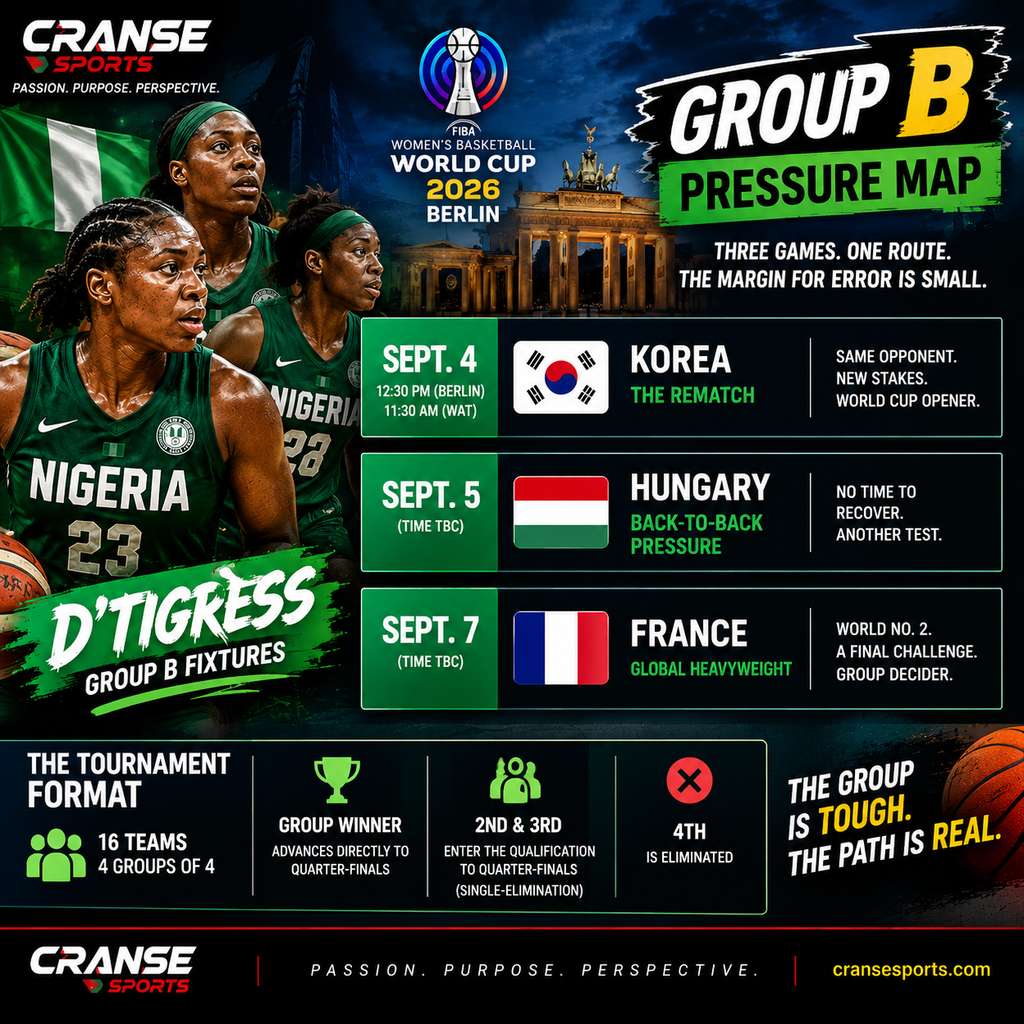
The expanded World Cup contains 16 teams split into four groups of four.
Each group winner advances directly to the quarter-finals.
Teams finishing second and third must survive a separate single-elimination qualification game to reach the last eight.
The team finishing fourth goes home.
So losing the opener would not eliminate Nigeria.
But it could make the path considerably more uncomfortable.
Nigeria’s Group B schedule reads:
Korea — September 4
Hungary — September 5
France — September 7
There is very little breathing room.
Beat Korea and D’Tigress immediately establish position before the back-to-back Hungary game.
Lose to the same opponent again and Nigeria enter Saturday already needing to manage a shrinking margin for error — with world power France still waiting.
That is why Friday matters.
Not because Nigeria’s tournament ends if they lose.
Because their route becomes harder almost immediately.
Nigeria’s Veteran Core Carries the Burden
If D’Tigress are going to reverse the March result, experience will have to become an advantage rather than a burden.
Ezinne Kalu remains one of the emotional and organisational centres of the team.
During the qualifying tournament she averaged 4.8 assists and 2.2 steals, underlining how much of Nigeria’s rhythm runs through her.
Inside, Nigeria possess serious power.
Victoria Macaulay averaged a team-best 13.6 points during qualifying.
Murjanatu Musa averaged 7.2 rebounds, while also providing size, physicality and rim protection.
And then there is Amy Okonkwo, a two-time AfroBasket MVP whose ability to produce decisive offensive moments gives Nigeria another proven pressure option.
That is an experienced core.
But experience cuts both ways.
Nigeria’s depth, particularly in the backcourt, will matter across a tournament played against elite opposition.
The schedule makes that issue immediate.
Nigeria play Korea and Hungary on consecutive days.
Rotation is therefore not a later tournament problem.
It starts immediately.
Korea Are More Than a Revenge Story
Reducing Friday to revenge would undersell the opponent.
Korea are ranked 15th in the world and qualified for Berlin after a strong run in Villeurbanne that included wins over Nigeria and Colombia before they secured their ticket with a 105–74 victory over the Philippines.
They also carry significant World Cup history, with 2026 marking their 17th appearance.
Their danger is not theoretical.
Nigeria have already felt it.
Park Jihyun’s scoring hurt D’Tigress in March, while Korea also possess experience inside through Park Ji Su and perimeter danger around a team comfortable punishing defensive mistakes.
Their victory over eighth-ranked Nigeria was one of the notable ranking upsets of the qualifying tournaments.
Nigeria therefore enter Friday with the higher ranking.
Korea enter with the fresher head-to-head proof.
Berlin gets to decide which matters more.
Hungary Comes Quickly — France Waits Later
Another reason the opener carries weight is what follows.
There is barely time for emotional recovery or celebration.
Hungary arrive the next day.
France, one of the tournament’s strongest teams, close Nigeria’s group schedule.
And France have their own recent evidence against D’Tigress: they beat Nigeria 93–86 during the March qualifying tournament.
So Group B contains two opponents who defeated Nigeria only months before the World Cup.
That strips away any temptation to treat Nigeria’s African dominance as a guarantee of comfortable progression.
There is a path to a deep tournament.
There is also a group capable of exposing every weakness.
Eighth Place Is the Old Benchmark. Can D’Tigress Go Higher?
Nigeria have already changed perceptions of African women’s basketball.
Paris 2024 did that.
Another AfroBasket title reinforced it.
But sporting authority is built by repeating breakthroughs.
That is the opportunity in Berlin.
D’Tigress have enough pedigree to believe a top-eight finish is no longer the summit.
A top-seven finish would establish a new Nigerian global benchmark.
The question is whether Nigeria can turn belief into tournament control.
And fittingly, the answer begins against the opponent that provided one of the clearest warnings during qualifying.
Korea have already shown Nigeria what happens when D’Tigress lose control of a game.
Friday gives Nigeria the chance to show what they learned from it.
Africa has already been conquered.
Berlin is about something harder: proving D’Tigress can keep climbing when the opposition is global.
CRANSESPORTS
Passion. Purpose. Perspective.
