


Rivers United Survived San Pedro Away. Now the Pressure Comes Home
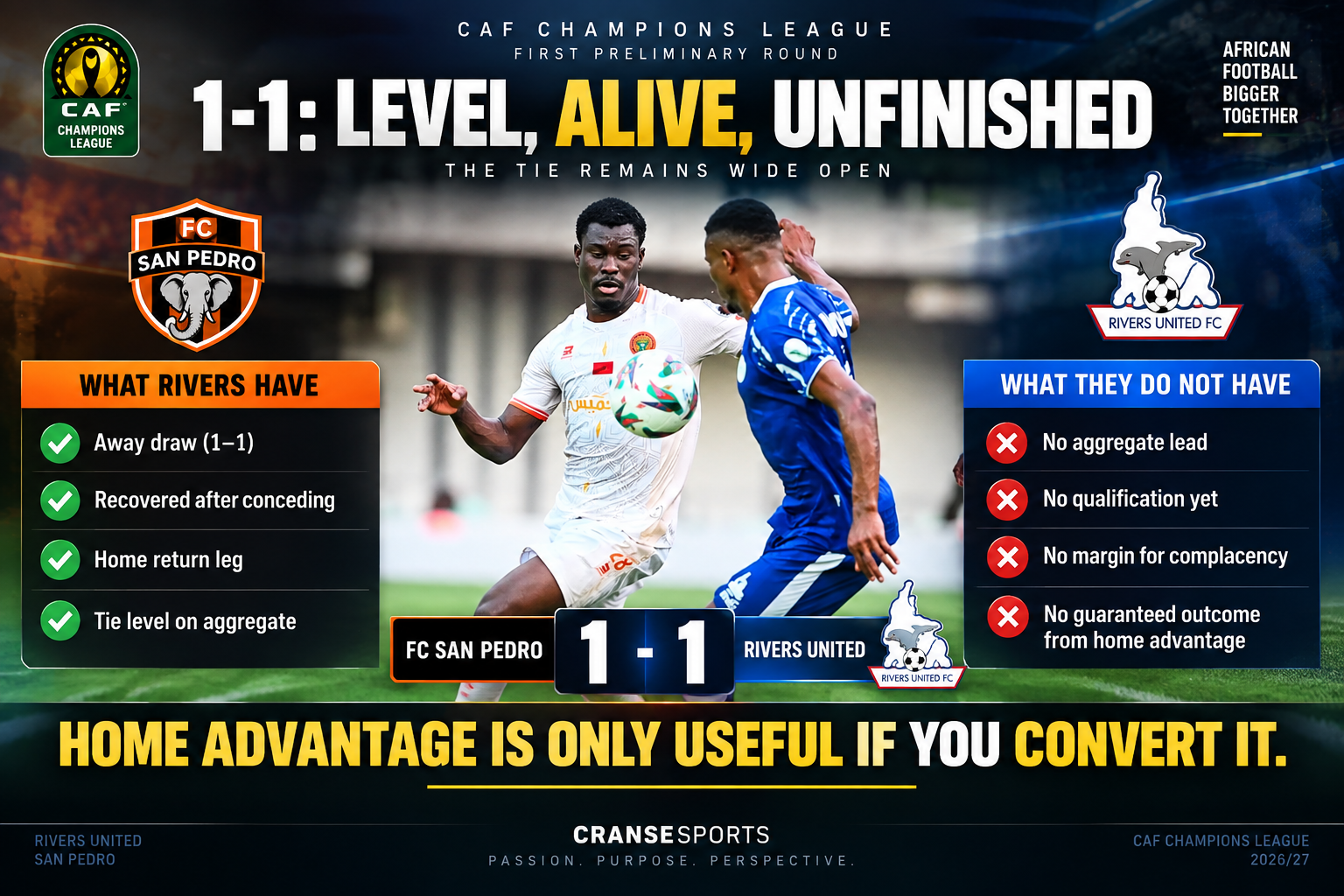
Rivers United left Côte d’Ivoire with a 1–1 draw against FC San Pedro after recovering from a goal down in their CAF Champions League first-leg tie. The result keeps the contest level and moves the decisive leg back to Nigeria. The away test has been survived. Now Rivers must turn that platform into qualification.
Rivers Went Behind — But They Did Not Break
There are away draws in continental football that feel routine.
This was not one of them.
Rivers United left Côte d’Ivoire with a 1–1 draw against FC San Pedro in the first leg of their CAF Champions League preliminary-round tie after recovering from going behind in the second half.
The first 45 minutes ended goalless.
Then came the pressure.
San Pedro took the lead after the restart.
Rivers suddenly faced the possibility of returning to Nigeria with a deficit and a more complicated qualification problem.
Instead, they responded.
Iyowuna Douglas equalised, restoring parity and changing the shape of the tie before Rivers headed home.
The scoreline now reads 1–1.
No advantage on aggregate.
No qualification secured.
But Rivers United have returned from one of the more difficult parts of the assignment without losing.
That matters.
Now the pressure changes.
Iyowuna Douglas Changed the Shape of the Tie
An equaliser in an away first leg can carry significance beyond the goal itself.
San Pedro had momentum.
They had the lead.
They had the opportunity to force Rivers United into a rescue mission in the return fixture.
Douglas prevented that.
His goal did not give Rivers an away-goal advantage.
There is no need to manufacture one.
What it did was remove San Pedro’s lead and ensure the decisive leg begins level.
That is an important distinction.
Rivers no longer need to chase the tie from kickoff.
They can approach the return game knowing qualification remains completely within reach.
But that also creates expectation.
At 1–1, the responsibility to impose themselves now moves toward the Nigerian side.
1–1 Is a Platform, Not Qualification
There is always a danger in celebrating a good away result too early.
Rivers United should recognise the value of what they achieved in Côte d’Ivoire.
They should not confuse it with the job being done.
The aggregate score is level.
San Pedro still need only one strong performance in Nigeria to overturn the entire argument around the first leg.
That makes the return match a different tactical challenge.
Away from home, Rivers could absorb pressure, manage difficult phases and value survival.
At home, supporters and circumstance will demand more.
They will need to carry the game for longer periods.
Create chances.
Control transitions.
Avoid giving San Pedro the kind of early goal that would immediately change the emotional balance of the tie.
The draw provided a platform. Qualification still has to be earned.
The Pressure Has Shifted From Survival to Expectation
That may be the most important consequence of the first leg.
In Côte d’Ivoire, a draw is a result most Nigerian clubs would take.
At home, it becomes a starting point rather than an achievement.
Rivers United will now be expected to finish the job.
And that expectation brings its own danger.
Teams can become impatient when the home crowd expects an early breakthrough.
They can overcommit.
They can turn territorial dominance into defensive vulnerability.
They can allow the pressure to score to become more dangerous than the opponent.
Rivers therefore need balance.
They must play with enough aggression to make home advantage meaningful.
But they also need the discipline to recognise that a two-legged tie is not won by emotion.
It is won by control.
Last Season’s Group-Stage Experience Must Count for Something
Rivers United are not approaching this campaign without recent continental experience.
They reached the 2025/26 CAF Champions League group stage but failed to advance, finishing behind Pyramids and RS Berkane in Group A.
That campaign exposed how unforgiving the competition becomes once the standard rises.
But simply reaching that stage also gave Rivers experience many clubs entering preliminary rounds do not possess.
They have already travelled.
Already managed difficult away environments.
Already experienced the tactical punishment that comes when mistakes are made against stronger African opposition.
That experience now has to become useful.
Because continental maturity is not measured only by how far a club reached in the previous season.
It is measured by whether those lessons improve the next campaign.
A 1–1 away draw against San Pedro gives Rivers an opportunity to show exactly that.
Nigeria Needs Clubs That Can Finish Continental Jobs
There is a broader Nigerian football issue here too.
For years, Nigerian clubs have entered CAF competitions carrying domestic reputation but struggled to convert that status into sustained continental relevance.
Good opening performances are not enough.
Promising away draws are not enough.
Qualification is what ultimately changes the conversation.
Rivers United have already done something useful.
They avoided defeat away.
They recovered after conceding.
They return home level.
Now comes the part that has often separated promising Nigerian campaigns from meaningful African runs.
Finishing the tie.
That is why this return leg carries more than Rivers United’s immediate ambition.
It sits within a wider question about whether Nigerian clubs can become more reliable in continental competition.
San Pedro Will Not Arrive to Protect 1–1
There is another side to the pressure.
San Pedro have no reason to approach the return leg timidly.
They know the tie is level.
They know Rivers will carry greater home expectation.
And they know that frustration inside the stadium could become useful if they keep the game scoreless for long enough.
That gives Rivers another challenge.
Patience.
The Nigerian side cannot allow the match to become a race against the clock too early.
They need to make San Pedro defend.
Move them.
Test them.
But remain structurally secure enough that one counterattack does not turn home advantage into panic.
This is where game management becomes more important than possession statistics.
The aim is not simply to dominate the ball. It is to dominate the tie.
Côte d’Ivoire Was the Test. Home Is the Examination
Rivers United did what they needed to do away.
They stayed alive.
They responded after conceding.
They brought the tie home level.
That deserves credit.
But the standard changes now.
The return fixture is no longer about whether Rivers can remain competitive away from home.
It is about whether they can convert a competitive position into progression.
Last season’s continental experience should help.
Home conditions should help.
The psychological lift of Douglas’ equaliser should help.
But none of those things qualify Rivers United automatically.
The score remains 1–1.
The tie remains alive.
And the responsibility now belongs to the Nigerian club.
Côte d’Ivoire gave Rivers United a platform.
Home must now turn it into qualification.
