



- Nigeria enters the 2026 FIBA Women’s Basketball World Cup with history behind them, expectation in front of them—and a 17-point defeat to Korea that gives today’s opener a tactical edge.
By IDNN–Cranse Sports Desk
BERLIN, Germany — D’Tigress will step onto the Berlin Arena court this afternoon carrying the confidence of African champions—but also the memory of what Korea did to them barely six months ago.
Nigeria’s opening game at the 2026 FIBA Women’s Basketball World Cup is not a ceremonial introduction. It is a rematch with consequences.
In March, during the World Cup qualifying tournament in France, Korea pulled away from D’Tigress to win 77–60. Nigeria stayed within four points at halftime but were eventually broken by Korea’s passing, perimeter shooting and fourth-quarter execution. FIBA’s qualifying game centre
That defeat gives Friday’s Group B opener its true edge.
Nigeria are not walking into the unknown. They have already seen the speed, movement and precision Korea can produce. The question in Berlin is whether Rena Wakama’s team have learned enough to prevent the same tactical problems from returning on the bigger stage.
Korea Left Nigeria a Warning in Lyon
The 17-point margin from March tells only part of the story.
The qualifying-game statistics underline how Korea created the separation: they finished with 29 assists and converted 11 three-pointers, while Nigeria made only four shots from outside.
That is the danger again in Berlin.
Korea do not need to overpower Nigeria physically if they can shift defenders, create open perimeter looks and force D’Tigress to spend the afternoon chasing the ball. Their speed is not limited to transition; it also appears in the timing of their passes and the movement surrounding the ball-handler.
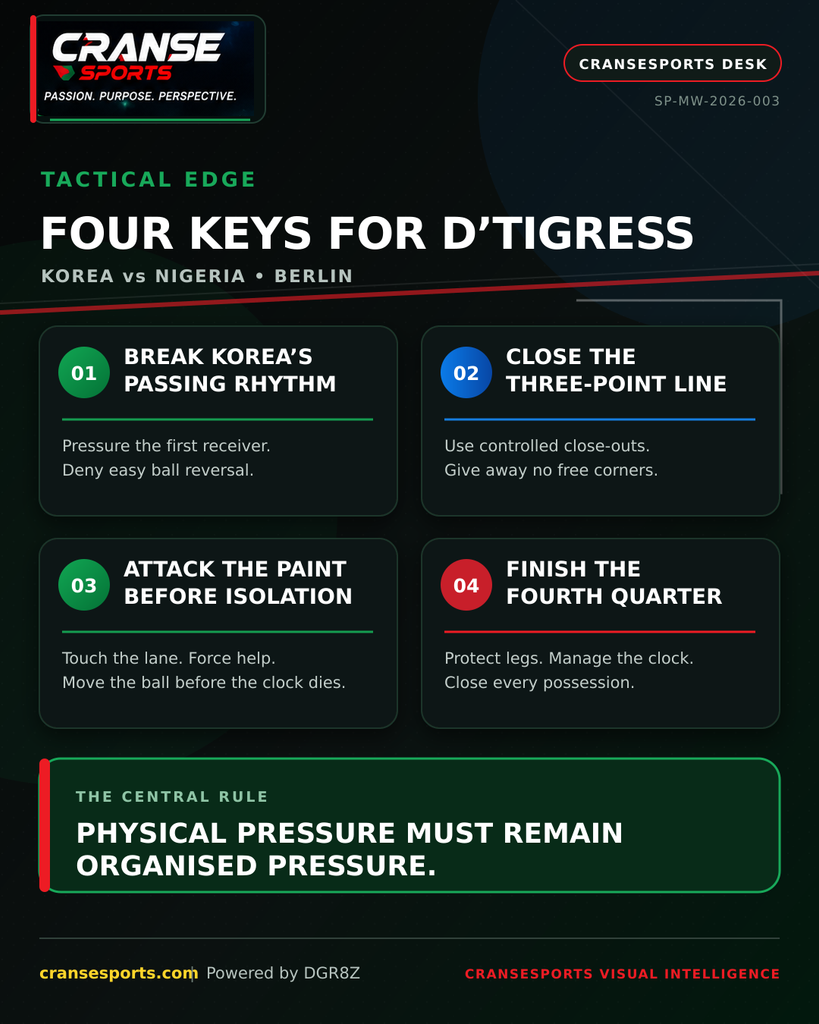
Nigeria’s first task, therefore, is not simply to play hard. It is to disrupt Korea’s rhythm before it becomes comfortable.
The guards must apply pressure without giving away cheap fouls. Close-outs must be controlled. Help defenders cannot collapse so deeply into the paint that Korea’s shooters are left unattended.
If Nigeria repeatedly lose the first defensive rotation, Korea will find the extra pass.
The Tactical Battle Starts at the Perimeter
D’Tigress are at their most dangerous when defence becomes attack.
Their physicality, aggression and ability to turn loose possessions into transition opportunities have been central to their rise. Ezinne Kalu supplies leadership and control, while Amy Okonkwo, Promise Amukamara, Murjanatu Musa and Nigeria’s supporting cast give Wakama several possible combinations.
But Nigeria cannot rely on emotion alone.
Korea will attempt to neutralise Nigeria’s physical advantage by moving the ball faster than defenders can recover. D’Tigress must decide when to switch, when to fight through screens and when to protect the paint without surrendering the arc.
That balance could determine the game.
Overcommit to the perimeter and Korea may attack the gaps. Retreat too far and Nigeria risk another barrage of open three-pointers.
The premium tactical requirement is discipline: aggressive enough to disturb Korea, organised enough not to be manipulated by Korea’s movement.
Nigeria Must Avoid the Half-Court Trap
The other examination will come when Nigeria cannot run.
D’Tigress thrive when they create turnovers, attack before the defence is set and use their athleticism in open space. Korea’s objective will be to reduce those moments and force Nigeria into repeated half-court possessions.
That is where patience becomes essential.
Nigeria cannot allow the offence to collapse into late-clock isolation or hurried perimeter attempts. Kalu must establish control early, the ball must enter the paint and Nigeria’s forwards must force Korea to defend through contact.
The objective is not only to score inside. Paint pressure can draw extra defenders, create offensive-rebound opportunities and open cleaner shots on the perimeter.
Nigeria must also protect each possession. Empty trips will feed Korea’s confidence and deny D’Tigress the chance to impose their physical advantage.
The Fourth Quarter Cannot Repeat Itself
March’s qualifier remained competitive for long periods before Korea closed the door.
Nigeria were outscored 19–9 in the fourth quarter, turning a manageable contest into a clear defeat. That finish should sit at the centre of Wakama’s game management in Berlin.
Rotation decisions will matter. So will the timing of Nigeria’s defensive pressure.
D’Tigress face Hungary less than 24 hours after the opener, but they cannot preserve themselves so cautiously that Korea are allowed to control today’s game. At the same time, exhausting the core players too early could leave Nigeria vulnerable late.
The answer lies in purposeful rotation—not rotation for its own sake. Every unit must preserve defensive intensity, rebounding effort and offensive structure.
If Nigeria enter the final quarter within striking distance, composure must replace urgency. Korea have already shown that they can execute when the game tightens.
One Victory Could Change the Group
The tournament format raises the value of the opener.
The team finishing first in each group advances directly to the quarterfinals. The second- and third-placed teams must survive a single-elimination qualification game, while the fourth-placed team exits the competition. FIBA’s official competition format
Nigeria face Hungary on Saturday before completing the group phase against European powerhouse France on Monday.
That sequence makes Korea more than the first opponent. They may be Nigeria’s clearest opportunity to establish control before the group becomes more complicated.
A victory would provide momentum and place immediate pressure on Hungary. A defeat would not end Nigeria’s campaign, but it would narrow the margin for error and revive uncomfortable questions from the qualifying tournament.
History Has Changed the Standard
D’Tigress are no longer judged like a team grateful merely to appear.
In 2018, they became the first African side to reach the quarterfinals of the Women’s World Cup. At Paris 2024, they became the first African women’s basketball team to reach an Olympic quarterfinal.
Those breakthroughs altered the standard.
FIBA now presents Nigeria as a team capable of surprising established powers. Kalu has argued that the warm-up results did not reveal Nigeria’s complete strength and insists the squad are ready to show a different level in Berlin. FIBA’s Ezinne Kalu feature
But status must be defended possession by possession.
At 1:30 p.m. Nigerian time, D’Tigress will not merely begin another World Cup. They will confront a team that recently exposed them—and receive an immediate opportunity to prove that the lesson was absorbed.
Berlin begins with a tactical debt.
Korea have already presented the evidence. Nigeria must show that the terms have changed.
