


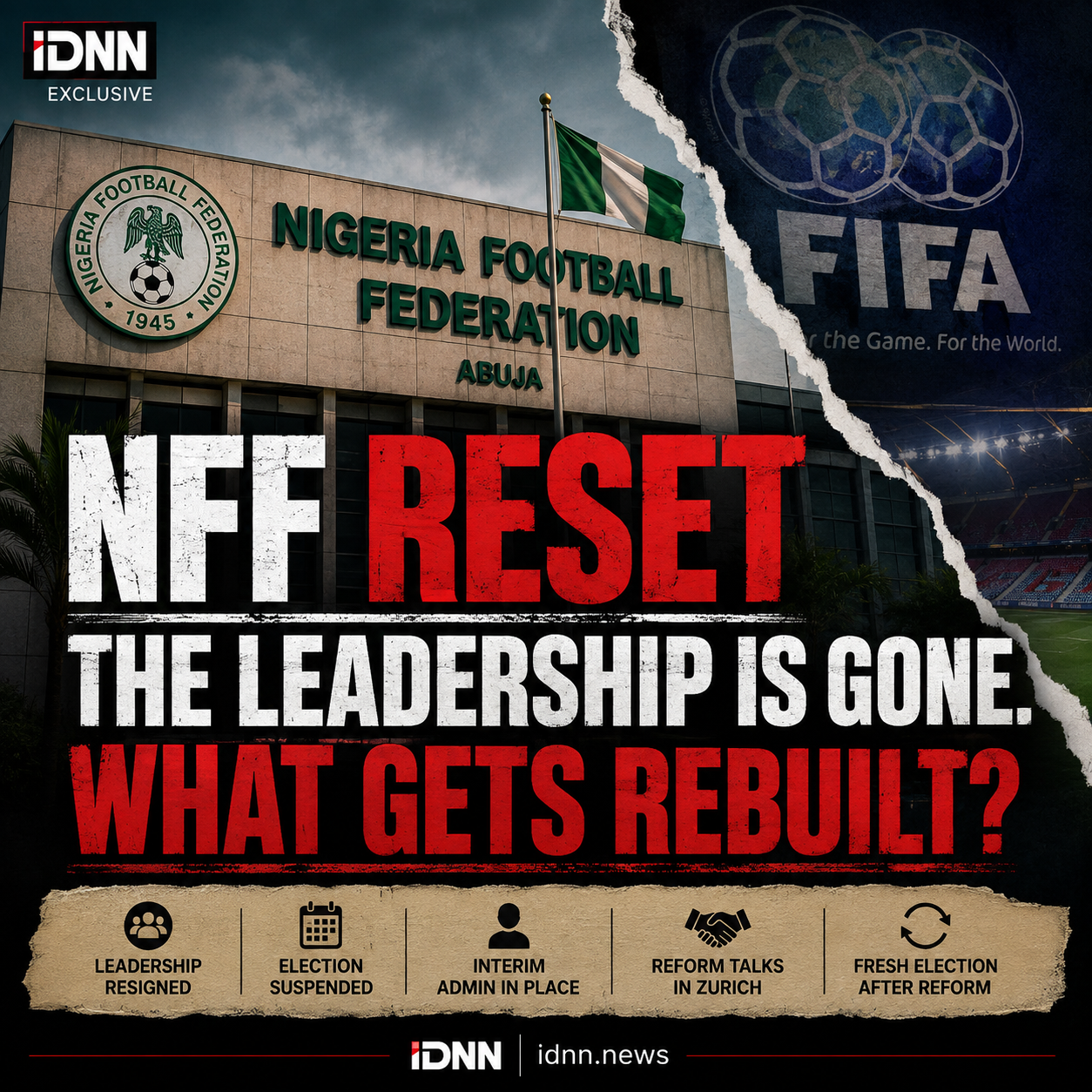
- For Nigerian football, removing the men at the top may prove to have been the easy part.
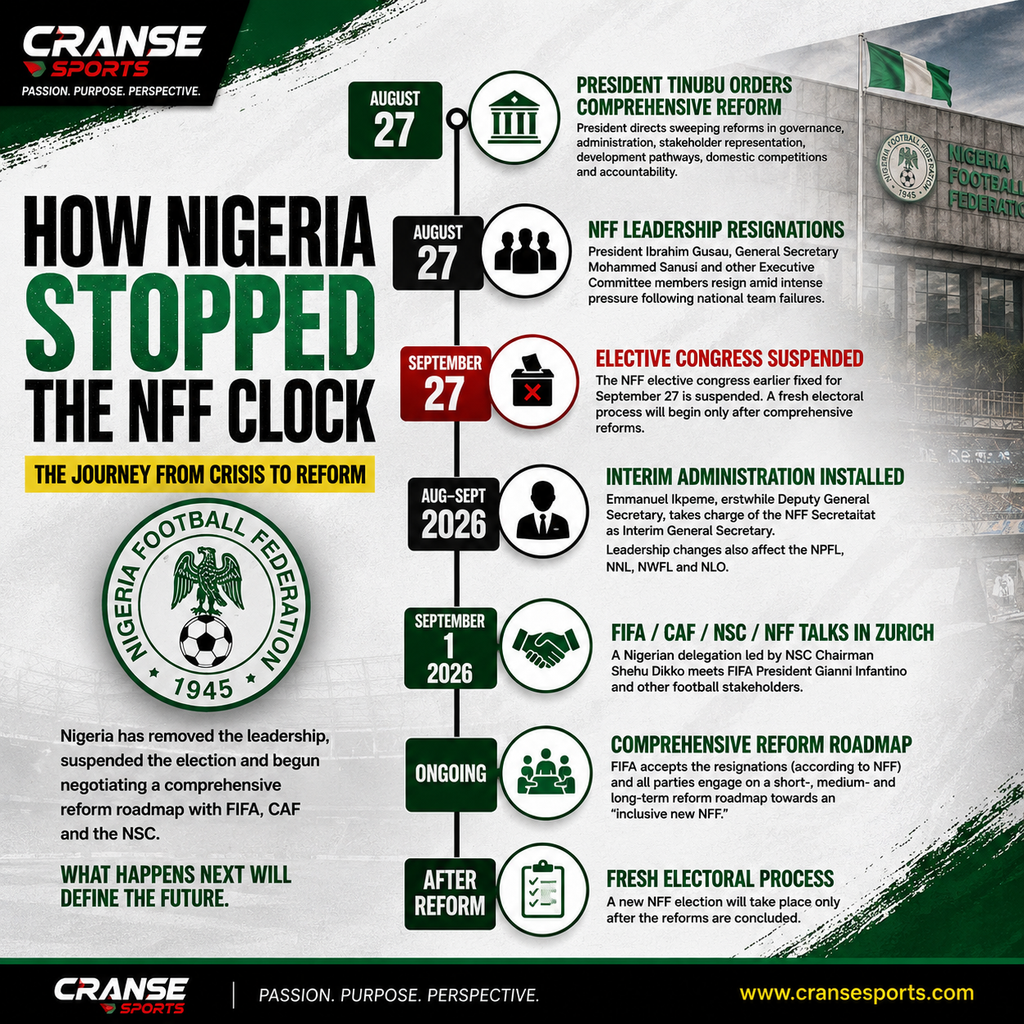
The resignation of Nigeria Football Federation President Ibrahim Gusau, General Secretary Mohammed Sanusi and other executive committee members on August 27 broke open a leadership structure already under enormous pressure after damaging national-team failures.
But their departure did not begin the reform conversation.
It accelerated one already underway.
Earlier that day, President Bola Tinubu directed a comprehensive reform of Nigerian football, identifying governance, administration, stakeholder representation, development pathways, domestic competitions and accountability among the areas requiring attention.
The presidential intervention described structural deficiencies — not merely poor results or unpopular personalities — as part of the problem confronting the game.
That distinction now sits at the centre of everything that follows.
Because Nigeria is no longer dealing simply with an NFF leadership vacancy.
It is confronting a question about the architecture of football itself.
Nigeria Has Already Stopped the Election Clock
The clearest indication that this is no routine succession process came immediately after the resignations.
The NFF’s elective congress, previously scheduled for September 27, was suspended.
Rather than simply proceeding to another election to replace the departed leadership, the federation said a fresh electoral process would begin only after the anticipated comprehensive reforms.
That is a significant break from business as usual.
Former Deputy General Secretary Emmanuel Ikpeme was placed in charge of the NFF Secretariat as interim General Secretary, preserving administrative continuity while the larger transition unfolds.
Changes were also made around the administrative leadership of Nigeria’s domestic football structure, touching the Nigeria Premier Football League, Nigeria National League, Nigeria Women Football League and Nationwide League One.
Taken together, those moves sharpen the real significance of the moment.
Nigeria has not merely lost an NFF president.
It has paused the old succession timetable while deciding what the next system should look like.
FIFA Is Talking Structure, Not Just Names
That transition moved to Zurich this week.
A Nigerian delegation led by National Sports Commission Chairman Shehu Dikko, alongside NSC Director-General Bukola Olopade and football officials, met FIFA President Gianni Infantino and other international football stakeholders.
According to the NFF, FIFA accepted the resignations of the federation’s principal officers and discussions are continuing among FIFA, CAF, the NSC and NFF administration towards a short-, medium- and long-term reform roadmap.
The stated objective is the emergence of what the federation has described as an “inclusive new NFF.”
Infantino’s own public comments after the engagement are important because they pushed the discussion beyond personalities.
He spoke about institutional, governance and developmental issues, stronger structures and better pathways capable of creating more opportunities for Nigerian youth.
That language goes directly to a weakness Nigerian football has struggled to escape.
Administrations change.
Coaches change.
Committees are dissolved.
Elections come and go.
Yet disputes around accountability, development, domestic competitions, stakeholder representation and federation governance repeatedly return.
This time, the stated ambition is broader.
The question is whether the outcome will be.
‘Inclusive New NFF’ Sounds Powerful — But What Does It Mean?
This is where the reset becomes difficult.
An “inclusive new NFF” is an attractive promise.
But inclusion eventually has to become architecture.
Who gets represented?
How will the next leadership be chosen?
What changes in the electoral framework?
How will grassroots football, state associations, domestic leagues, women’s football, coaches, players and other stakeholders fit into the new structure?
What accountability mechanisms will exist when national teams fail, competitions struggle or development targets are missed?
And perhaps most importantly:
Will the reforms alter the incentives and power arrangements that have repeatedly produced governance battles around Nigerian football?
Those answers have not yet been publicly settled.
That must remain clear.
There is currently no verified basis for stating that FIFA has selected Nigeria’s next football leadership, approved a finished governance model or transferred control of the NFF to the National Sports Commission.
Nor should discussion around a possible normalisation mechanism be presented as an accomplished decision.
What has been established is substantial enough:
The old leadership has departed, the scheduled election has been stopped, transitional administration is operating and a wider reform roadmap is under discussion.
Nigeria Cannot Reform Football by Simply Changing the Faces
The pressure for this reset did not emerge from boardroom politics alone.
Nigeria’s failure to qualify for the 2026 FIFA World Cup intensified scrutiny of football leadership.
The Super Falcons’ failure to reach the 2027 Women’s World Cup compounded that damage, ending Nigeria’s record of appearing at every previous edition of the tournament.
The consequences therefore go beyond administration.
They are competitive.
Developmental.
Financial.
Reputational.
And increasingly institutional.
That is why the reform mandate covering governance, administration, representation, development pathways, domestic competitions and accountability matters.
It gives the current process a measurable test.
If the eventual outcome merely replaces one president with another while retaining the same weaknesses underneath, Nigeria will have changed the faces without changing the football.
The Power Question Has Not Disappeared
There is another difficulty the reform process must survive: legitimacy.
The National Sports Commission has become a major driver of the reform push.
FIFA remains the international authority responsible for protecting the statutory independence and obligations of its member associations.
CAF has a continental interest.
The interim NFF administration must maintain institutional continuity.
And Nigerian football itself contains constituencies with sharply different interests and different definitions of reform.
Those forces do not automatically align.
Dikko has framed the Zurich engagement as part of continuing work involving the NSC, NFF administration, CAF and FIFA within the relevant football statutes, rules and regulations.
That matters.
Because a reform created to solve one governance crisis cannot afford to produce another.
Too little change risks preserving the old order.
Too much political intrusion risks triggering a different institutional problem.
The eventual framework must therefore achieve something Nigerian football reform has repeatedly struggled to secure:
Change with legitimacy.
The Fresh Election Cannot Become the Old Election With New Names
Perhaps the strongest test will come when the suspended electoral process eventually resumes.
The sequence is now critical.
Reform first.
Then a fresh electoral process.
That creates an opportunity — but also a danger.
If the promised structural reforms genuinely alter accountability, representation, development priorities, domestic competition administration and governance standards, the next election could mark the beginning of a different football order.
But if reform merely clears the path for another contest among familiar power blocs operating under substantially the same arrangements, the pause will have achieved little.
Nigeria has changed NFF presidents before.
It has changed executive committees before.
It has promised football reform before.
This reset will therefore not be judged by the drama of the resignations.
It will be judged by what exists when the election clock starts running again.
The Next NFF Will Be Judged by What Actually Changes
The resignation of Gusau and other senior officials was dramatic.
But resignation is not reform.
The suspension of the September 27 election makes that clearer.
Nigeria has deliberately interrupted the normal succession process while discussions continue over what should replace the old structure.
Zurich has now internationalised that conversation.
FIFA is talking about stronger structures.
The Nigerian government has identified structural deficits.
The NSC is pushing a reform agenda.
CAF is engaged.
The NFF administration is operating through transition.
And a fresh electoral process is expected only after the reform phase.
That leaves Nigerian football facing a far bigger decision than who becomes the next NFF president.
The leadership question will eventually be answered.
The harder question is whether the system waiting for that leadership will actually be different.
Nigeria has removed the old leadership and stopped the old election clock.
Now comes the real test: can it rebuild the football system before starting the clock again?
