


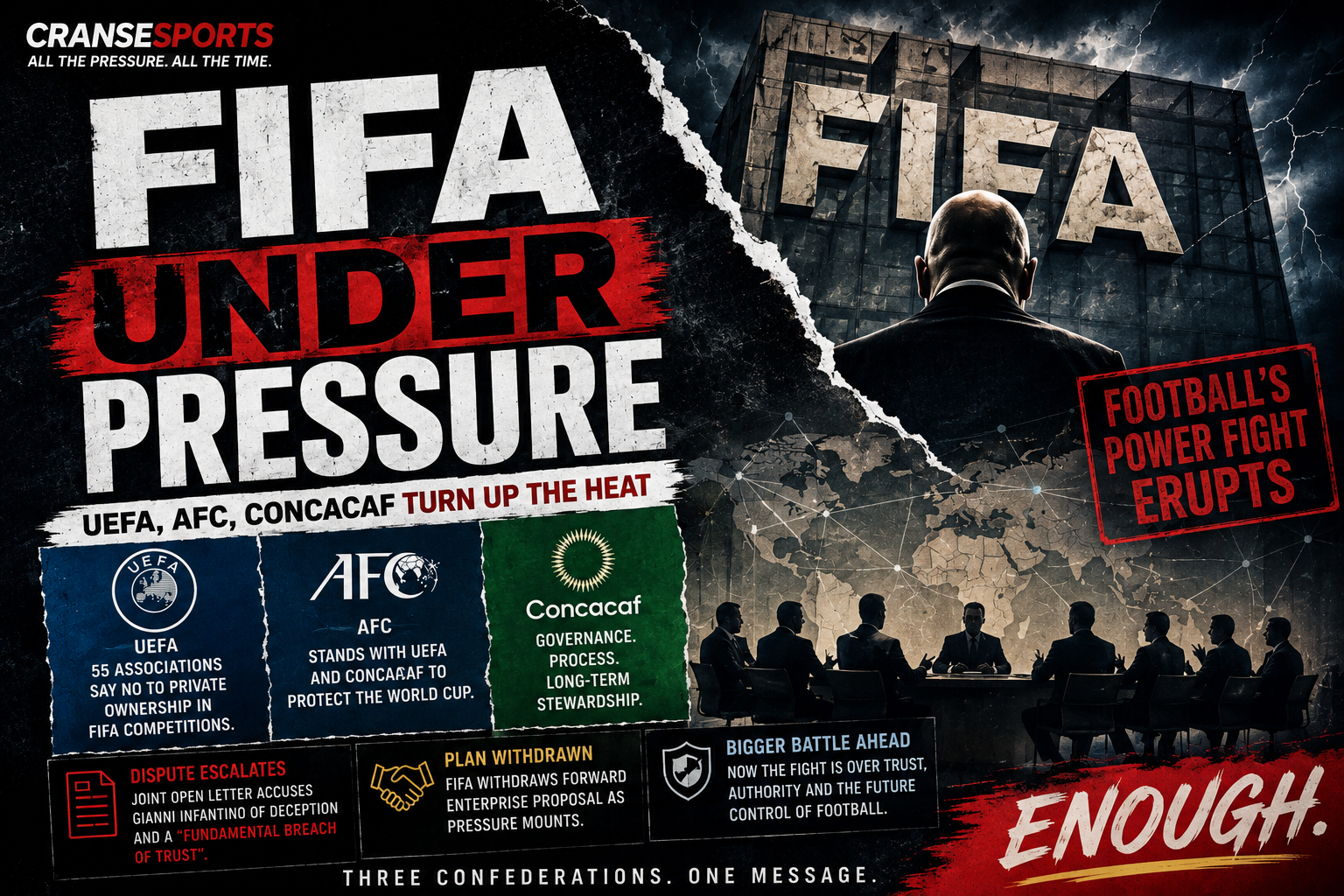
The fight over who controls the commercial future of world football has broken into the open.
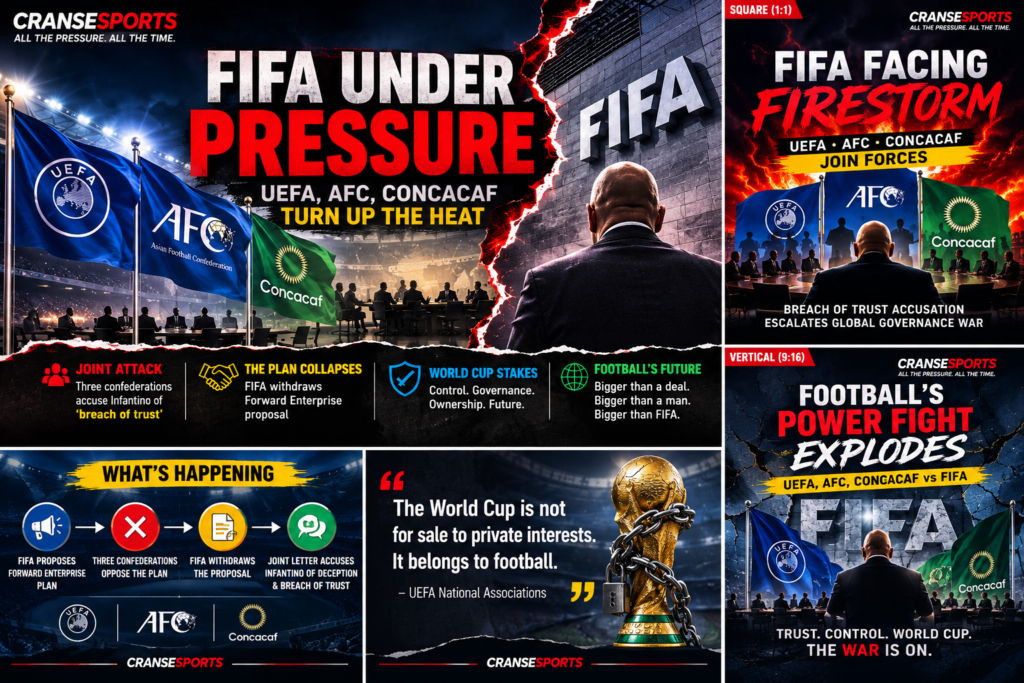
UEFA, the Asian Football Confederation and Concacaf have escalated their confrontation with FIFA president Gianni Infantino, accusing him of a fundamental breach of trust over the handling of the controversial FIFA Forward Enterprise proposal.
The dispute centres on a plan that would have created a new commercial structure around FIFA competitions and opened the door to private investment.
That proposal has now been withdrawn.
The political damage has not disappeared with it
UEFA had already taken one of the strongest positions against the plan, saying its 55 national associations opposed transferring ownership interests in FIFA competitions, including the World Cup, to private investors.
Concacaf also raised concerns about the process behind the proposal, stressing the need for proper governance, consultation and long-term stewardship of football’s major competitions.
The AFC publicly aligned itself with UEFA and Concacaf in opposing the plan.
FIFA eventually withdrew the Forward Enterprise proposal, a decision welcomed by the confederations.
Normally, that could have closed the argument.
Instead, the dispute has widened.
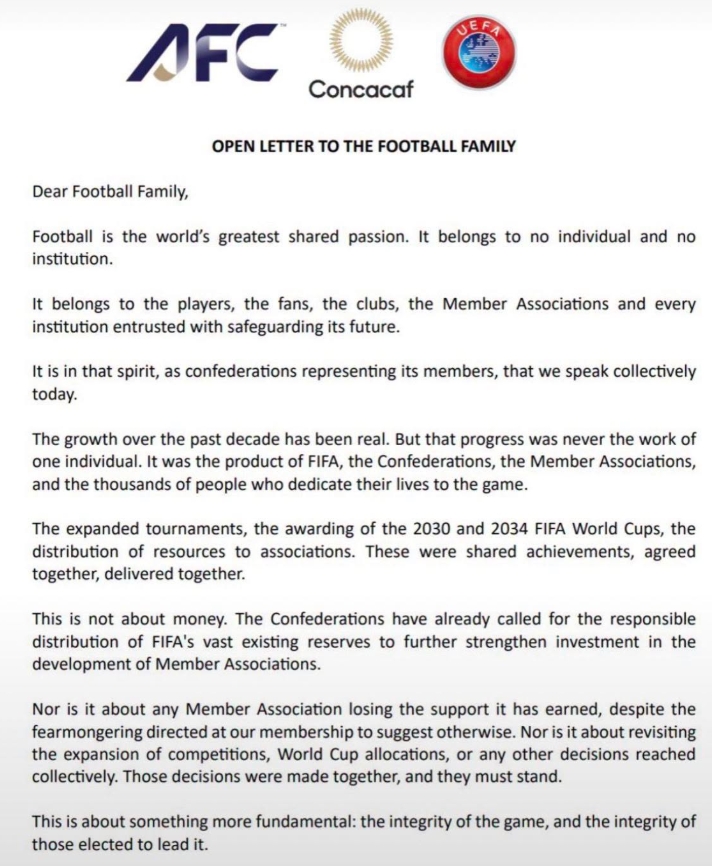
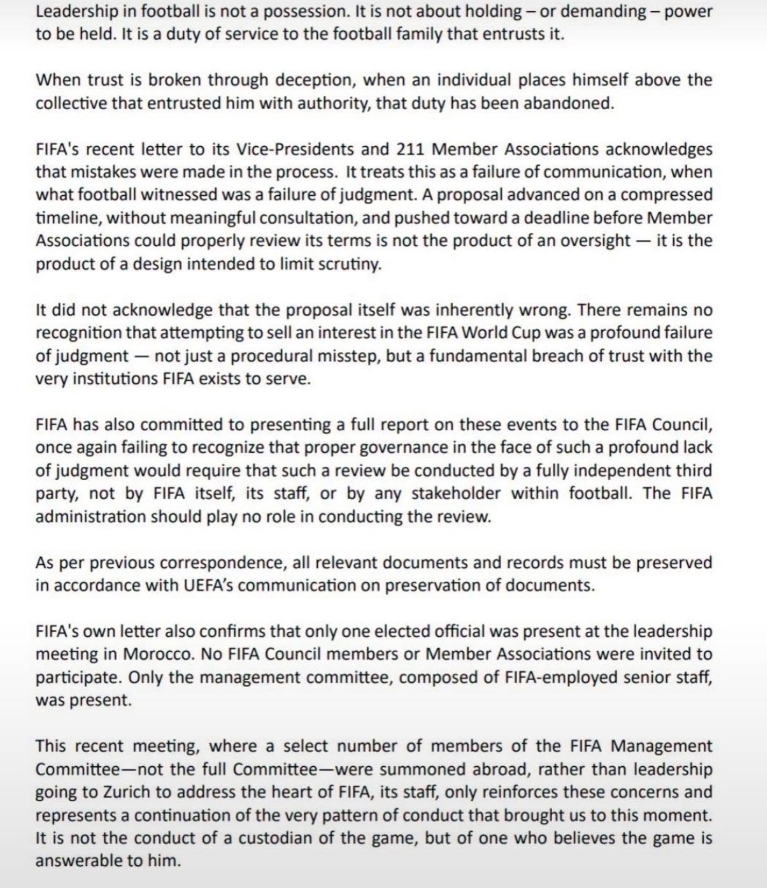
The Associated Press reports that UEFA, the AFC and Concacaf have now issued a joint open letter accusing Infantino of deception and describing the handling of the proposal as a “fundamental breach of trust”.
Those allegations remain the confederations’ claims and are not an independent finding of misconduct against the FIFA president.
But their intervention changes the scale of the confrontation.
This is no longer simply a disagreement over a commercial structure.
Three major continental confederations are now openly questioning the process and leadership behind an idea that could have reshaped the commercial control of FIFA’s most valuable competitions.
The stakes are enormous
The World Cup is FIFA’s flagship event and one of the most commercially powerful properties in global sport.
Any proposal involving private interests in competitions of that size immediately raises questions about ownership, revenue, governance and who ultimately controls decisions around the game’s biggest assets.
UEFA’s opposition was particularly forceful.
Its position framed the World Cup and other FIFA competitions as part of football’s collective structure rather than assets that should be opened to private ownership without broad agreement.
Concacaf’s intervention focused heavily on governance and process, while the AFC backed the wider resistance to the proposal.
The withdrawal removed the immediate commercial battle. It did not repair the trust problem.
That is now the more dangerous issue for FIFA.
Commercial ideas can be rewritten or abandoned. Relationships between a global governing body and three continental confederations are much harder to repair once accusations of deception enter the conversation.
For supporters, the argument may sound like boardroom politics.
Its consequences are much bigger
The dispute reaches into how the World Cup is governed, how football’s biggest competitions generate revenue and how much power FIFA’s leadership should have when reshaping the commercial architecture of the global game.
There is also an Africa-facing question.
CAF is not part of the three-confederation bloc leading the current confrontation.
If the dispute deepens, the position taken by Africa’s governing body — and by its member associations — could become increasingly important in determining how much political support FIFA’s leadership retains.
The Forward Enterprise proposal may be gone.
The battle over trust, authority and control of football’s future is not.
Cranse Sports
News For Fans Who Read The Game
