


Jannik Sinner’s Wimbledon title defence began with danger, doubt and a five‑set escape that reminded the entire tennis world how thin the margins can be on grass.
The defending champion clawed back from two sets to one down to defeat Miomir Kecmanovic 4‑6, 6‑3, 6‑7(6), 6‑2, 6‑3, surviving both a stubborn opponent and a third‑set fall that briefly threatened to turn his opening match into something far more serious.
This was not the controlled, comfortable first round Sinner wanted. It was the kind Wimbledon specialises in.
Kecmanovic struck first, taking the opening set and dragging Sinner into rallies that forced the Italian out of rhythm. When the Serbian edged the third‑set tiebreak, Centre Court felt the tension shift. The defending champion was one set from a major upset.
Then came the moment that froze the stadium.
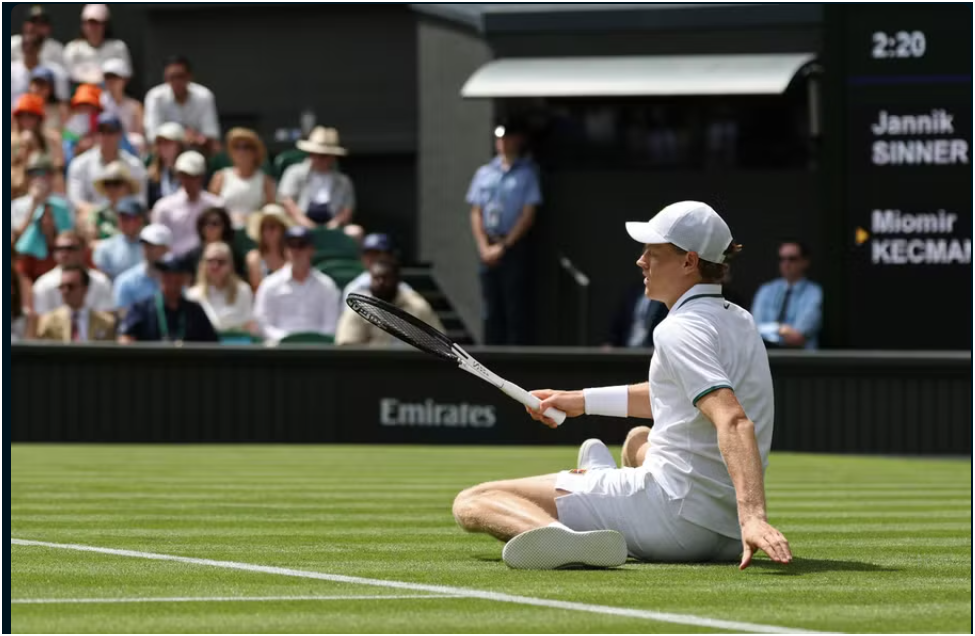
Sinner slipped near the baseline and clutched his left hip — the kind of fall that can end a tournament in a heartbeat. On grass, one wrong landing can change everything. One hesitation after it can change a match.
Sinner refused both outcomes.
He stood up, kept moving, and slowly dragged the contest back under his control.
A Champion Finds The Answer
The match turned the moment the third set ended.
Down two sets to one, Sinner lifted his level, stormed through the fourth set 6‑2 and then tightened his grip on the decisive moments in the fifth. His movement steadied, his shot‑making sharpened, and Kecmanovic’s window closed.
After the match, Sinner admitted he was “lucky” — acknowledging how quickly things can go wrong on grass — and stressed the importance of trusting his movement after the fall.
That was the real test.
Grass rewards confidence and punishes fear. Once a player starts tip‑toeing, the court feels bigger, the rallies feel heavier, and the opponent senses blood.
Sinner could not afford that.
So he moved through the scare instead of playing around it.
Wimbledon Has Already Asked Its First Question
This wasn’t a statement of dominance.
It was a statement of nerve.
And for a defending champion, that matters. Early danger at a Grand Slam can expose weakness, but it can also sharpen a player faster than any routine win. Sinner has already had to absorb scoreboard pressure, manage a physical scare and fight through a dangerous opponent before the tournament has properly opened.
His title defence is alive.
But the warning is clear.
Wimbledon will test him physically as much as technically. The grass can shift a match in one movement, and Sinner has already felt how thin the margin can be.
Borges Awaits After The Escape
Sinner now moves into the second round to face Portugal’s Nuno Borges — a different matchup, but one carrying its own pressure. The champion is through, but his opener showed how quickly comfort can disappear on grass.
He avoided the upset. He avoided the injury scare.
Now he must turn survival into control.
Cranse Sports continues to raise the bar for global tennis coverage.
Cranse Sports: https://cransesports.com
