


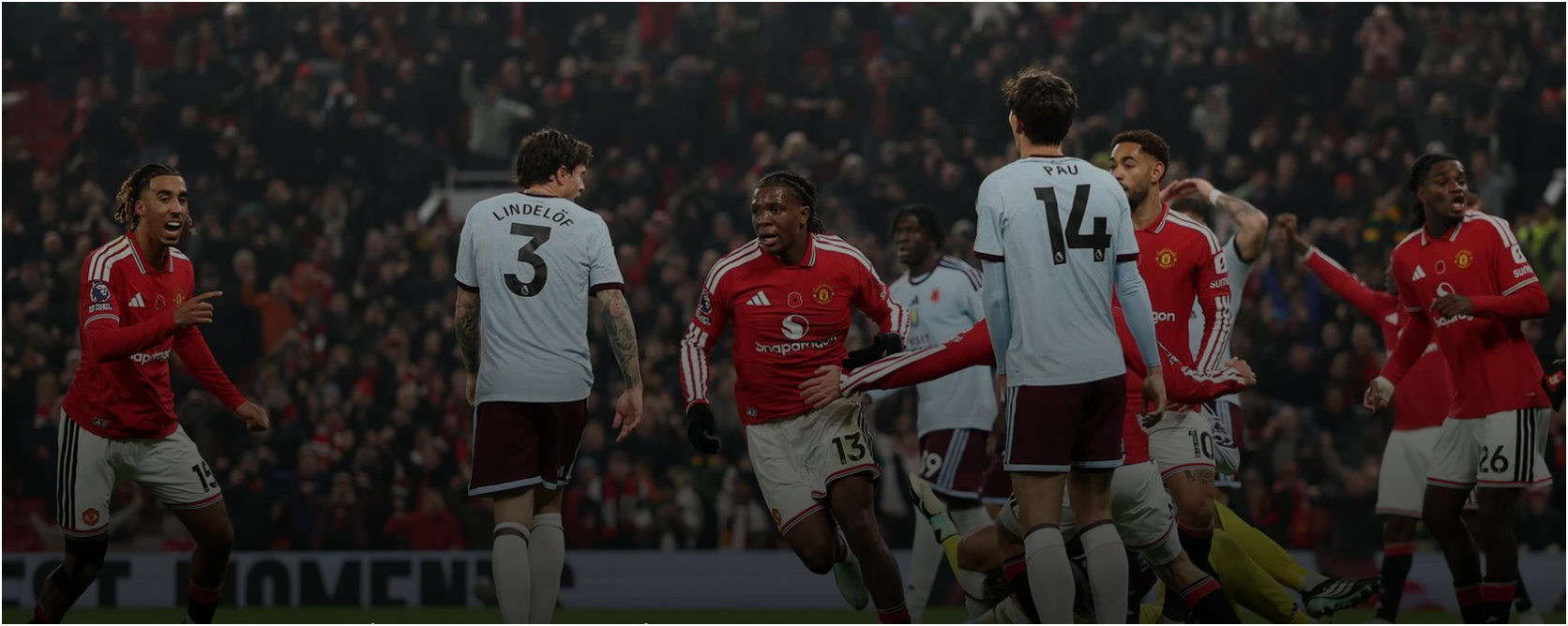
Manchester United staged an extraordinary stoppage-time comeback to draw 4–4 with Aston Villa at Old Trafford, but Patrick Dorgu’s dramatic equaliser could not disguise the defensive problems keeping Michael Carrick’s side in the Premier League relegation zone.
Manchester United twice recovered from two-goal deficits to salvage a remarkable point against Aston Villa on Sunday, 8 November 2026.
Joshua Zirkzee struck in the 92nd minute before substitute Patrick Dorgu headed home a controversial equaliser four minutes later, completing one of the Premier League season’s most dramatic recoveries.
But the celebrations masked an uncomfortable reality.
United had conceded four goals at home, twice allowed Villa to establish commanding leads and remained 18th in the Premier League after ten matches.
For Carrick, the performance demonstrated his players’ determination.
It also exposed the defensive instability threatening their season.

Villa Strike Twice Inside Four Minutes
United’s afternoon began disastrously.
Aston Villa opened the scoring inside the first minute when Alysson finished a move involving Nicolas Jackson and John McGinn.
The Brazilian winger beat goalkeeper Senne Lammens to give Unai Emery’s side an immediate advantage.
Before United could reorganise, Villa struck again.
Lammens failed to hold another effort from Alysson, allowing Jackson to convert the rebound from close range.
United were 2–0 down inside four minutes — the earliest they had fallen two goals behind in a Premier League match.
The home side appeared overwhelmed.
But their response was impressive.
Fernandes and Tielemans Restore Parity
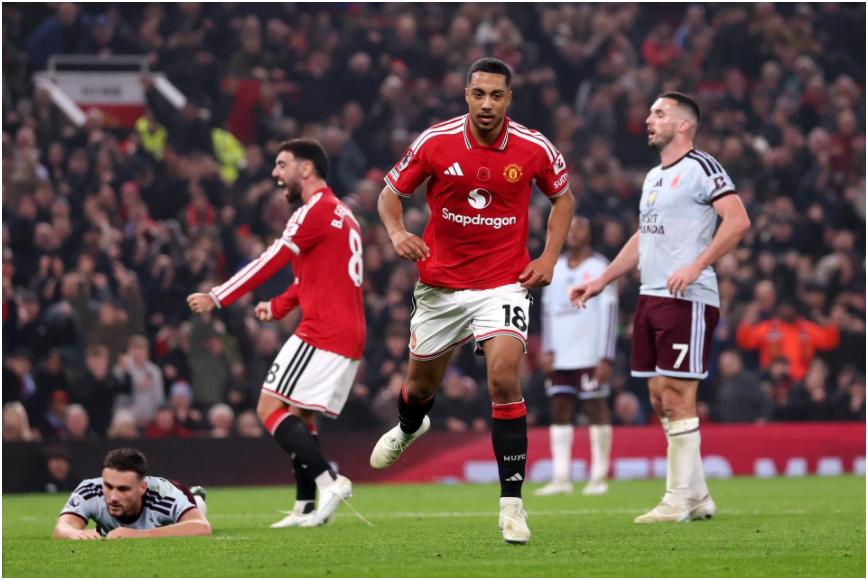
Bruno Fernandes began United’s recovery in the 16th minute.
Matheus Cunha was brought down inside the penalty area by Boubacar Kamara, and the United captain converted the resulting spot-kick.
The goal transformed the momentum.
United began creating opportunities, with Cunha, Amad Diallo and Fernandes repeatedly testing Villa’s defence.
Goalkeeper Zion Suzuki made several important interventions as the hosts searched for an equaliser.
Their persistence was rewarded shortly before halftime.
Noussair Mazraoui advanced down the right and delivered a cutback that allowed Youri Tielemans to score against his former club.
United had recovered from 2–0 down to reach the interval level at 2–2.
For a moment, Carrick’s team appeared to have regained control.
But the second half exposed the same weaknesses that had undermined their opening minutes.
United’s Defensive Problems Return
Villa needed only three minutes after the restart to reclaim the lead.
Diogo Dalot brought down Alysson inside the penalty area, and McGinn converted the resulting penalty.
Five minutes later, Villa struck again.
McGinn’s free-kick caused confusion inside United’s penalty area.
Leny Yoro headed the ball towards his own goal, and it struck the crossbar before Jackson helped it into the path of Leon Goretzka.
The midfielder finished from close range to make it 4–2.
United had conceded twice at the beginning of each half.
The pattern was difficult to ignore.
Their defensive problems were not limited to one incident.
The opening goals exposed failures in defensive positioning and goalkeeping execution.
The second-half goals resulted from a conceded penalty and poorly defended set-piece situation.
United possessed enough attacking quality to recover, but repeatedly surrendered the advantage through different defensive weaknesses.
For much of the remaining second half, Villa appeared capable of protecting their lead.
Then Carrick’s substitutes transformed the contest.
Dorgu Inspires an Extraordinary Stoppage-Time Escape
Patrick Dorgu entered the match in the 66th minute, while Joshua Zirkzee was introduced in the 83rd.
Both would become central figures in United’s remarkable recovery.
With Villa still leading 4–2 entering stoppage time, Dorgu delivered a cross that Zirkzee converted in the 92nd minute.
The goal gave United renewed hope.
They committed players forward in search of an equaliser, including goalkeeper Lammens for a late corner.
Fernandes delivered from the left, and Dorgu rose to head home in the sixth minute of added time.
Old Trafford erupted.
Dorgu had assisted United’s third goal and scored their fourth, transforming a seemingly certain defeat into a draw.
But the equaliser also produced controversy.
Villa Question Dorgu’s Equaliser
Aston Villa disputed the circumstances surrounding United’s fourth goal.
Goalkeeper Zion Suzuki appeared to encounter interference as he attempted to deal with Fernandes’ corner.
Villa manager Unai Emery subsequently questioned whether United goalkeeper Senne Lammens had impeded Suzuki.
The incident was reviewed, but the goal was allowed to stand.
The decision meant United completed their second recovery from a two-goal deficit.
For Villa, it was a painful conclusion to a match they had controlled for significant periods.
The controversy added another dimension to an already extraordinary encounter, although the official result remained unchanged.
United’s Fighting Spirit Cannot Hide Defensive Instability
The comeback demonstrated United’s resilience.
It did not resolve their defensive problems.
Conceding twice inside four minutes represented a disastrous opening.
Allowing Villa to score twice again within eight minutes of the second-half restart was equally concerning.
The goals emerged from different situations, including open play, a goalkeeper’s failure to hold a shot, a penalty and a poorly defended set piece.
That variety matters.
United’s vulnerability cannot be explained by one mistake or one individual performance.
The match exposed problems across several phases of defending.
Carrick’s side demonstrated that they possess the attacking quality to recover from difficult situations.
But repeatedly requiring extraordinary comebacks is not a sustainable strategy.
A team fighting near the bottom of the Premier League cannot consistently concede four goals and expect its forwards to rescue the result.
United Remain in the Relegation Zone
Despite the late celebrations, Manchester United remained 18th in the Premier League following the draw.
They had collected eight points from their opening ten league matches and had not won a Premier League fixture since August.
The international break provides Carrick with an opportunity to address those problems.
United’s attacking persistence offers encouragement.
Their league position demands improvement.
The challenge is no longer simply finding goals.
It is establishing the defensive stability necessary to turn attacking performances into victories.
Emery Left Frustrated as Villa Surrender Victory
For Aston Villa, the result represented two points lost rather than one gained.
Emery’s side produced excellent attacking spells, particularly at the beginning of both halves.
Alysson and Jackson punished United’s early defensive uncertainty.
McGinn and Goretzka then restored Villa’s two-goal advantage after halftime.
But Villa failed to manage the closing stages.
Their inability to defend two stoppage-time attacks transformed an important away victory into a draw.
The result extended Villa’s unbeaten Premier League sequence to six matches and left them tenth heading into the November international break.
However, Emery will be concerned by his team’s inability to protect a 4–2 lead so late in the contest.
The Bigger Picture
The eight-goal thriller offered two contrasting conclusions.
Manchester United demonstrated extraordinary determination, refusing to accept defeat despite twice falling two goals behind.
Aston Villa showed enough attacking quality to establish commanding advantages but lacked the defensive control to finish the job.
For United, the central question remains unresolved.
How much longer can attacking resilience compensate for defensive instability?
Dorgu’s dramatic equaliser rescued a point and delivered an unforgettable finish.
But when the celebrations fade, Carrick will still be looking at a team in the relegation zone.
United rescued the result. They have yet to solve the problems behind it.
