


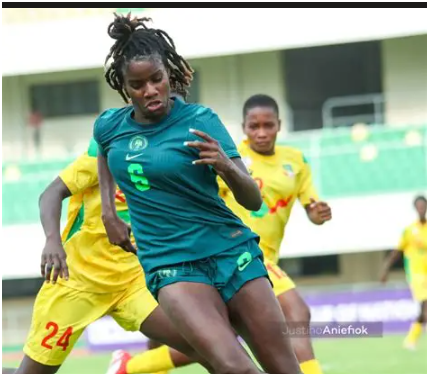
Esther Okoronkwo’s comeback could not have arrived at a better moment for Nigeria. As the Super Falcons enter the decisive stretch of their WAFCON 2026 build‑up, one of their most reliable attacking midfielders is finally back in competitive action — and the timing matters.
Okoronkwo was listed in AFC Toronto’s official match feed as a 65th‑minute substitute during their 3–1 win over Vancouver Rise, confirming earlier reports of her late return from injury. For Nigeria, that single line in a club match report carried national‑team significance.
The Women’s Africa Cup of Nations is closing in. Morocco awaits. And Okoronkwo’s fitness now sits at the centre of one of Justine Madugu’s biggest selection decisions.
According to the PUNCH Sports Extra report, Okoronkwo had been sidelined for nearly two months after suffering a meniscus injury in a league clash against Halifax. The setback ruled her out of Nigeria’s two friendlies against Senegal — matches the Super Falcons won 5–1 on aggregate.
Her return isn’t just a club update.
It reopens a national‑team question.
Madugu’s Selection Puzzle Gets Bigger
A fully fit Okoronkwo gives Nigeria a different kind of attacking dimension. She can operate between midfield and attack, link play in the final third, and deliver the kind of passes that break tight tournament matches open.
Her WAFCON pedigree is proven. In Morocco two years ago, she was one of Nigeria’s standout performers as the Super Falcons claimed a record‑extending 10th continental title — scoring twice and supplying seven assists.
That history changes the conversation.
Her return doesn’t simply add another name to the squad list. It potentially restores one of Nigeria’s most effective tournament weapons.
But the fitness question remains.
A late return is encouraging, but it does not automatically guarantee she is ready for the physical demands of a full WAFCON campaign. Madugu must now judge whether she can reach tournament speed in time.
WAFCON Stakes Raise the Pressure
Nigeria will compete in Group C alongside Malawi, Zambia and Egypt, opening their campaign against debutants Malawi in Rabat on July 28.
It is a manageable group — but not a gentle one.
Zambia bring firepower. Egypt bring North African tournament edge. Malawi bring the unpredictability of a debutant with nothing to lose.
Experience becomes priceless in such a mix.
Okoronkwo has already shown she can influence WAFCON matches, and her return will be closely monitored by Nigeria’s technical crew. The stakes are higher than usual: WAFCON 2026 doubles as a qualifier for the 2027 FIFA Women’s World Cup in Brazil. The four semi‑finalists qualify automatically, while another team enters the intercontinental playoff.
Every squad decision now carries World Cup consequences.
Return Is Only Step One
Okoronkwo’s comeback is undeniably good news for Nigeria.
But the sharper question is how quickly she can build rhythm — and how much she can realistically give.
The Super Falcons do not just need bodies. They need players ready for tournament pace, group‑stage pressure and knockout intensity. If Okoronkwo climbs back to full sharpness quickly, Nigeria regain creativity, experience and a proven WAFCON performer at exactly the right moment.
For Madugu, her return creates a bigger decision.
For the Super Falcons, it gives their WAFCON push a stronger pulse.
